Lubricant trends
Creating value in an era of uncertainty
29 September 2026
25 August 2026
The protection, performance and durability risks of using inadequately validated ‘suitable for use’ engine oils

The lubricant industry, oil marketers and additive companies built robust performance credibility over decades to gain formal approval against industry and OEM specifications. However, a growing number of engine oils are being marketed as ‘suitable for use’ (SFU). For those SFU engine oils, the absence of independent verification or formal approval raises fundamental questions about product capability, consistency and accountability. Robin Scott, Infineum Head of Technology Capabilities, explains how, to ensure sufficient protection and performance is delivered to increasingly sophisticated vehicle architectures, it is important to avoid using engine oils carrying poorly substantiated SFU claims.
Currently the majority of the global automotive market is being served by engine oils holding official industry and/or OEM claims. While reputable lubricant manufacturers may choose to offer SFU products, with technical performance based on extensive testing and data, lower quality products with poorly substantiated SFU claims without independent verification or formal approval are also entering the market.
Without action, the increasing prevalence of inferior engine oils marketed with terms including SFU, ‘meets the requirements of’, or ‘recommended for’ specific applications could become a serious issue for the whole industry.
OEM and industry approvals are fundamentally different from SFU claims. The American Petroleum Institute (API) and the European Automobile Manufacturers’ Association (ACEA) require that engine oils making claims against the API or ACEA market standards, are subject to extensive laboratory evaluations and meet exacting standards of performance. Similarly, OEM approvals require oils to undergo rigorous testing programmes that often include proprietary engine tests and field trials. The resulting approvals provide assurance that an engine oil has demonstrated compliance with all specified performance criteria and that manufacturing quality systems are capable of consistently producing the approved formulation.
Click here to read our previous article about the organisations and systems in Europe that are designed to improve the quality of lubricants in the marketplace.
SFU claims are very different and are typically self-declarations by the lubricant marketer, where there may have been no independent verification. The lubricant marketer may only rely on formulation modelling, supplier recommendations, read across from similar formulations or limited testing rather than completing the full qualification programme.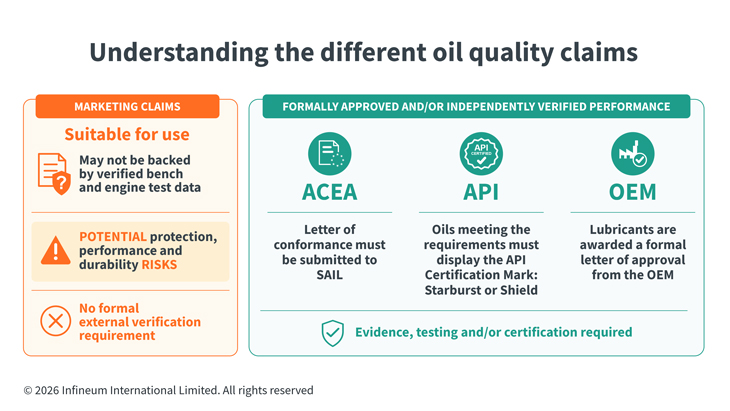
Being able to differentiate between approved or independently verified formulations and SFU oils becomes increasingly important as engine hardware evolves. Downsized turbocharged gasoline engines, hybrid powertrains, advanced emission control systems all demand engine oils that deliver exceptionally stable performance over longer oil drain periods in increasingly challenging operating conditions.
OEMs have identified several performance attributes as particular areas of concern including controlling turbocharger deposits and timing chain wear and preventing low-speed pre-ignition (LSPI) - all of which require carefully balanced additive chemistry and appropriate base stock selection. Meanwhile, tightening sulphated ash, phosphorus and sulphur (SAPS) limits mean careful engine oil formulation is needed to ensure advanced aftertreatment systems are adequately protected without compromising engine durability and in-service emission compliance.
In these critical performance areas underperforming or inadequately validated SFU engine oils may present the greatest risk.
Two organisations in Europe are involved with verifying lubricant specifications. Services to Associations and Industry in the Lubricants sector (SAIL) is a subsidiary of the Technical Association of the European Lubricants Industry (ATIEL), which monitors product compliance against ACEA claims on a global basis. Verification of Lubricant Specifications (VLS), a subsidiary of the UK Lubricants Association (UKLA), is an independent organisation that works to verify lubricant specifications in a number of end-use applications in the UK market.
SAIL Director, Mike Boyer, says that their 2025 market surveillance programme examined 330 lubricant products purchased from the marketplace across a broad range of countries. More than 3,300 laboratory tests were conducted to verify key physical and chemical characteristics against the requirements of the ACEA Oil Sequences. They found that 84% of products were fully compliant with their declared ACEA performance claims, while 16% (53 products) exhibited one or more non-compliance(s). He points out that this represents a significant improvement over 2024, when 79% of products were fully compliant, demonstrating that industry efforts to improve product quality and manufacturing consistency are delivering measurable results.
In 2025, VLS opened 21 cases to investigate complaints about a range of passenger vehicle and heavy-duty engine oils. Alan Outhwaite, VLS Technical Review Panel Chairman, who says 2026 is already a busy year, explains that most of the recent case types are due to failure to meet ACEA and OEM specifications when tested and concerns over un-evidenced OEM claims. He says there have been several cases concerning the validity of claims to the Stellantis FPW 9.55535/03 specification made by some lubricant marketers. Most of these cases have now been resolved, pending a six month review per standard VLS procedures.
Alan continues that VLS has also noted in several recent cases that the recommended applications for passenger car engine oil products have been inaccurate or over generalised on labels or technical data sheets. In such cases advisories have been given to the lubricant marketers. In response to this observation VLS updated its marketing claims guidelines earlier this year which can be viewed here, along with guidance from VLS on claiming approvals and suitable for use statements.
In the US, the State Department of Weights & Measurements can step in on misleading advertising aimed at consumers. The American Petroleum Institute (API) has an aftermarket audit program that looks at products carrying its API quality marks, while the Independent Lubricant Manufacturers Association (ILMA) has an enforceable Code of Ethics, which it says promotes integrity and quality in lubricant manufacturing and marketing, to which each ILMA member agrees to abide. GM also has an aftermarket audit that monitors its dexosTM1 licensed products in the market.
A worrying trend is the prevalence of SFU claims not only for obsolete claims but also in the premium OEM segment.
Recently, there have been two clear examples of how SFU engine oils can create uncertainty for distributors, workshops and end users.
The first example concerns the previously mentioned Stellantis FPW 9.55535/03 specification, initially introduced in 2023 to address reliability concerns linked to wet timing belt systems and diesel chain wear, where lubricant chemistry plays a critical role. Whilst oil marketer exclusive products were already approved, Infineum was the first to achieve official Stellantis FPW 9.55535/03 approval with a market general product in April 2026, enabling oil marketers to bring Stellantis-approved products to market with confidence. However, other suppliers have also been making SFU-type claims.
In October 2025, VLS launched a widespread market investigation and issued a caution over engine oils making claims against the Stellantis FPW 9.55535/03 specification, used by vehicles including Peugeot, Citroën, DS, Fiat, Vauxhall and Opel models. While only four products have been approved against the specification, VLS research identified several brands marketing engine oils against it. Their investigation resulted in the withdrawal from sale of some products and revisions to product documentation for others, demonstrating the need for independent verification of SFU products.
The second example involves the VW 50400/50700 specifications, where Infineum formulations have been formally approved by Volkswagen. The Infineum product line carrying the Volkswagen approval is designed to meet Volkswagen's requirements, including wear protection, engine cleanliness, fuel economy and lubricant durability for extended oil drain intervals. VW 50400/50700 approved lubricants can be used in a wide range of Volkswagen Group engines and vehicles. However, SFU claims are starting to be made, and these will require verification to ensure unapproved formulations do not pose any risk to end users.
To protect engine oil quality across the supply chain a greater emphasis on evidence-based performance claims is needed. Industry bodies, OEMs and regulators should continue strengthening performance and aftermarket audit requirements in line with hardware evolution while also promoting clearer differentiation between formally approved engine oils and self-certified claims.
Lubricant marketers, who are responsible for ensuring that engine oils meet the claimed performance, should be encouraged to publish supporting technical evidence where approvals are absent, rather than relying solely on broad compatibility statements.
It is also important to educate marketers, distributors and workshops so that their procurement decisions extend beyond price and marketing claims to include evidence of approvals, manufacturing quality systems, formulation consistency and technical support.
To help with ACEA claims, ATIEL has recently published the Performance Data Packs Bulletin. This document reemphasises that lubricant marketers must be able to demonstrate supporting data passing limits for all required tests, for the ACEA engine oil sequence category claimed. In addition, a core principle of the American Chemistry Council (ACC) and Additive Technical Committee (ATC) Codes of Practice is documentation of approval testing in accordance with the Codes. Marketers may request this technical support for their products at any time.
Ultimately, OEM approvals and recognised industry validations provide independent verification and ensure engine oil quality.
For engine oils, SFU claims should not be viewed as equivalent to formal approvals. As engine technology continues to advance and performance requirements become increasingly demanding, running tests required by a given industry market standard or OEM specification, and passing the required limits, will remain the benchmark against which all engine oils should be judged. Greater transparency, stronger control and wider recognition of the distinction between self-declared suitability and independently validated approval will be essential to maintaining confidence in engine oil quality throughout the global supply chain.
Sign up here to receive email alerts so that you never miss out on new content from Infineum - and make sure you follow Infineum Additives on LinkedIn.
Sign up to receive monthly updates via email