Base stocks
RRBO in the spotlight
21 April 2026
29 September 2026
Asia faces continued pressure as Middle East supply remains uncertain through 2027

The demand for base stocks in Asia continues to grow, driven by industrial activity, vehicle parc expansion and ongoing formulation upgrades, making it an attractive market for suppliers. Following his recent presentation at the 18th ICIS Asian Base Oils and Lubricants Conference, Michael Connolly, Head of Refining and Base Oils Analytics at ICIS, shares his thoughts on how the market is adjusting to supply disruption from the Middle East and explains that, while prices might ease from crisis highs, product availability, approvals, freight and refinery economics will determine how quickly normal market conditions are restored.
Given that the Strait of Hormuz, has been largely blocked since the end of February 2026, can you give us an update on the impact the Middle East conflict is having on base oil supply in Asia and the expected rate of recovery?
In my view, the Middle East conflict remains a material constraint on Asian base oil supply, but the emphasis has shifted from an assumed near-term recovery to a longer period of instability, with recovery expected to be slower and more uneven than earlier forecasts
The earlier base oils view assumed the Strait would reopen and for progressive normalisation to start from late August, with the market moving back toward balance through 2027.
I think the key issue is that the crude/feedstock assumption has moved materially later than the base oils forecast assumed. The later crude forecast now points to a fragile October deal, but not a clean reset. Crude flows through the Strait are expected to continue at reduced levels and are likely to face repeated disruption through 2027. With a more reliable peace and proper reopening only from early 2028, recovery may start through H1 2028 and there could be a return to a new normal in H2 2028. For Asia, that means continued freight risk, higher logistics costs and intermittent supply interruptions, particularly for material linked to Middle East production and exports.
The market should not frame this as a short disruption; it is now a prolonged logistical and confidence shock with repeated risk premiums embedded into crude, gasoil and base oil supply chains.
Do you think the market could still move towards some form of normlisation in Q4 2026?
I am very cautious about saying the market could normalise in Q4 given the continued instability. However, I do expect Q4 to look better than the most disrupted months, especially if a deal is announced in October, but the new crude case implies a fragile and incomplete recovery rather than a clean return to normal. An emerging and relevant dynamic is that weaker premiums into other regions are reducing the incentive for Asia-origin deep-sea cargoes to move out of the region, which can leave more material available locally but also signals that the global arbitrage has softened. Russian refinery outages also matter here because they are helping to keep diesel/gasoil cracks elevated as the market replaces lost Russian product barrels. Light grades could remain more vulnerable if refinery economics stay skewed toward diesel and buyers rebuild only selectively.
Is the situation in the Middle East impacting all base stock Groups equally?
No, the impact is not equal across all the base stock groups. Group III is the clearest pinch point because Middle East supply is structurally more important to the global approved-grade balance, and Pearl GTL constraints are keeping that part of the slate exceptionally tight. Group II is less directly exposed, but it is being pulled tighter by substitution pressure where Group III availability is short and by refinery economics that still favour diesel/gasoil when cracks are strong. Russian refinery outages are reinforcing that dynamic: reduced Russian diesel/gasoil availability has tightened the global middle-distillate market, keeping cracks elevated and making distillate production more attractive relative to base oils. Group I is affected more through crude, freight and refinery run incentives than through the same structural scarcity, although heavy neutrals and brightstock remain relatively better supported.
How would you describe the recovery trends for Group I and II supply now?
I would say they are moving from acute disruption management into partial recovery, rather than full supply recovery. The market is no longer assuming a rapid normalisation: crude is expected to fall on any October deal announcement, but the latest forecast keeps Brent supported by recurring 2027 flare-ups and reduced Strait of Hormuz flows. Gasoil remains important because strong diesel cracks keep refiners economically incentivised to prioritise distillates over base oils. That incentive is being strengthened by Russian refinery outages, which have reduced diesel/gasoil exports and added another layer of tightness to the global middle-distillate market. That means Group I/II supply can improve as logistics ease, but refinery yield decisions may still cap the pace of recovery.
Group III supply has clearly been choked, do you see this a continuing situation? And, how does the situation at the Pearl GTL plant exacerbate Group III supply?
Yes, Group III remains the most choked segment, and this is likely to continue.
Earlier forecasts expected gradual recovery of Group III as Gulf logistics normalised and new capacity arrived, but the newer crude view means the underlying logistics and geopolitical risk could persist through 2027. Group III should therefore soften from crisis peaks only gradually, with approved-grade scarcity and OEM qualification constraints preserving a wide premium over Group II.
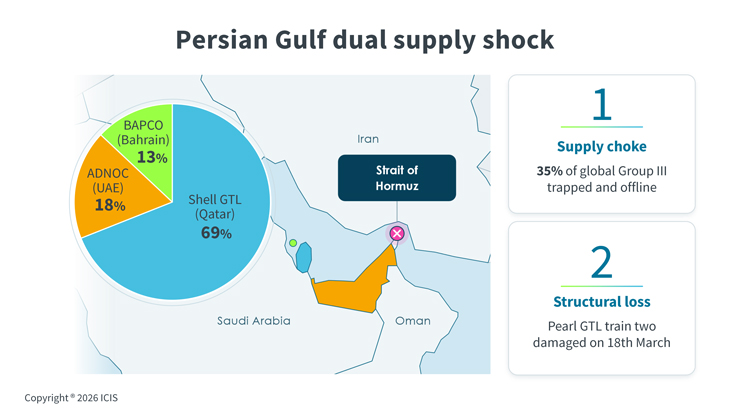
I see Pearl GTL as central to the Group III story because it is a significant source of high-quality Group III material, but the issue is now twofold: train availability and export logistics. There are two trains. One is available for use now, while the other is expected to be repaired in Q1/Q2 2027 and then ready for operation. However, both trains are dependent on the Strait of Hormuz logistics constraint being removed or materially eased before product can reliably move out of the region. So the market should not treat mechanical readiness as the same as effective supply recovery. Even if both trains are operational, Group III availability could remain constrained if shipping, insurance, routing and customer delivery channels through the Strait of Hormuz are still disrupted.
Can you give us an update of the Group III supply demand balance?
Group III supply has moved from a temporary shortage situation to one of structural tightness. North America is highly import-dependent, Asia has strong consumption growth and the Middle East remains the key surplus/export region, but that surplus is precisely where the disruption risk is concentrated. Europe, however, is in a difficult position given its heavy reliance on OEM-approved Group III, which has been significantly affected by the Persian Gulf outages. The balance is currently still tight, recovery is delayed, and the market is unlikely to fully normalise during 2027 under the new crude assumptions. Incremental capacity helps, but approvals, logistics and reliability mean the effective market balance improves later than nameplate capacity additions suggest.
Regarding the base stock market in Asia, what do you expect the demand picture to look like in terms of growth and how far behind is supply?
Asian base oil demand remains growth-oriented, driven by industrial activity, vehicle parc expansion and ongoing formulation upgrades. However, near-term demand is being capped by high prices, uncertainty and cautious buying. The bigger imbalance is on supply quality rather than total volume: Asia can cover more of its Group I/II needs through regional production and imports, but remains more exposed on Group III, especially approved material. In practical terms, demand growth is not collapsing, but supply recovery is lagging where Gulf-linked Group III and high-quality replacement molecules are needed.
Do you expect the capacity additions across the Middle East and Asia to come on stream as planned? Will this be enough to meet demand in the region? What do you expect the split between local consumption and export to be?
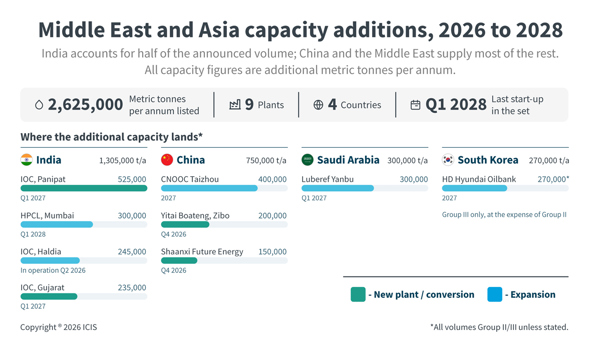
The expected Middle East and Asian additions still matter, but the timing risk has grown. Capacity relief is concentrated from Q4 onward, with further support through 2027, including announced China CTL/Group III additions. However, these additions do not immediately solve approved-grade availability, nor do they fully offset the risk of disrupted Gulf flows. I would say they are directionally enough to improve the balance, but not enough to remove tightness quickly if demand holds and Pearl/Gulf-linked supply remains inconsistent.
The likely split of local use vs export depends on the project, grade slate and approval status, but higher-value export markets will remain a major pull for new Group III capacity. Even where there is domestic need, producers may still prioritise exports if overseas premiums are materially higher; we are already seeing this behaviour in India, where export netbacks can compete with or outweigh local supply needs. That means local consumption should rise structurally as formulation upgrades and domestic lubricant demand grow, but new capacity will not automatically stay in-region. In practice, exports of Group III and approved material are likely to remain important, while domestic availability depends on whether local prices are high enough to retain barrels against export opportunities.
Given the continued uncertainty, what key messages do you have for market participants?
I have several key takeaway messages to reinforce.
In my view, while prices may ease from crisis highs, product availability, approvals, freight and refinery economics will determine how quickly customers feel real relief. Buyers should therefore plan for a slower, uneven recovery rather than assuming that an October deal immediately restores normal market conditions.
Sign up to receive monthly updates via email