Lubricant trends
The validation gap
25 August 2026
29 September 2026
A bright future depends on stronger collaboration, increased resilience and a focus on value

At Lubes Expo Europe held in Düsseldorf 15-17 September, senior leaders from across the lubricants and additive industry came together to discuss some of the biggest challenges facing the sector today. They covered topics including increasing regulatory complexity, geopolitical uncertainty, regionalisation of supply chains, electrification, and the need to demonstrate value in a changing market. While perspectives differed on specific issues, there was clear agreement on one point: the industry's future will depend on collaboration, resilience and a relentless focus on creating value for customers.
A central theme of the discussion was the impact of Europe's regulatory environment.
Leaders broadly agreed that regulation has played an important role in raising standards, improving environmental and health outcomes, and creating opportunities for higher performance products. However, concerns were expressed about the growing complexity of compliance and the resources required to navigate it.
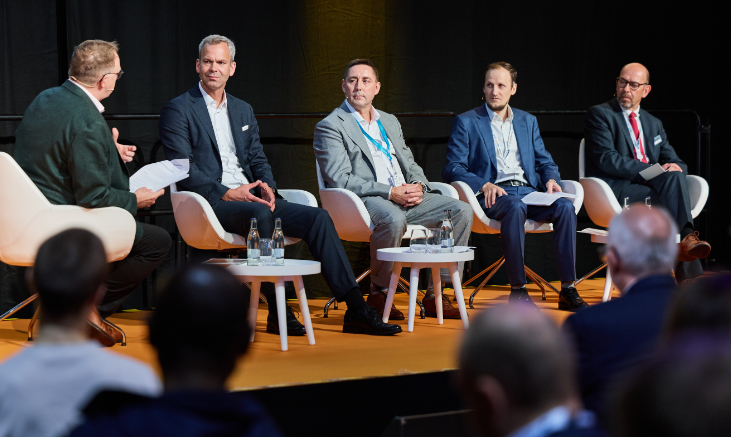
Leadership Panel at Lubes Expo Europe. Left to right Host: Mike McCabe, Thomas König, Schaeffler, Sander van Donk, Lubrizol, Konstantin Melnichuk, Kline and Chris Locke, Infineum
For Konstantin Melnichuk of Kline, regulation was both an opportunity and a challenge. He pointed to examples where regulatory requirements have accelerated demand for premium lubricants and renewable products, helping create future market opportunities. At the same time, he noted that Europe's slower economic growth presents challenges for industry investment and demand.
Sander van Donk of Lubrizol argued that Europe's regulatory ambition risks becoming regulatory complexity, diverting resources away from innovation and increasing costs for companies operating in the region. Thomas König of Schaeffler echoed this concern, highlighting the significant burden placed on technical and R&D teams that must dedicate increasing time and effort to compliance activities.
For Chris Locke of Infineum, regulation remains essential, but balance is crucial. "Regulation sets an important baseline, but we need to be careful to apply it where it genuinely adds value. Europe has often led the way and established standards that are later adopted elsewhere. However, if the burden becomes too great, investment decisions become increasingly challenging."
The discussion highlighted the importance of ongoing dialogue between industry and regulators, with several panellists advocating partnership approaches that deliver intended outcomes while reducing unnecessary complexity.
If regulation was one major theme, geopolitical uncertainty was another.
Responding to questions around tariffs, trade policy and global instability, panellists described what many saw as a fundamental shift away from decades of increasing globalisation.
Chris Locke noted that businesses today are navigating a very different world from the one that existed even a few years ago. "For more than 30 years the direction of travel was towards globalisation. Today we are seeing a significant move towards regionalisation, driven by geopolitical risk, supply chain disruption, climate challenges and changing customer expectations."
Several speakers observed that customers are becoming increasingly willing to diversify supplier relationships as a form of risk management. What was once viewed primarily as an efficiency exercise is now increasingly being shaped by resilience and security of supply.
For Lubrizol, this changing environment has strengthened the case for regional investment and stronger local presence in key markets, particularly in Asia and India. Regional supply networks, inventory strategies and closer customer proximity were all identified as important components of future competitiveness.
The consensus was that while global capabilities remain essential, organisations are increasingly determining which activities need to be localised to serve customers effectively and manage risk.
Perhaps the strongest area of agreement across the panel was the role of collaboration.
The industry has experienced a series of disruptions in recent years, from the COVID-19 pandemic and extreme weather events to geopolitical tensions and logistics challenges. While these events have created significant pressure, many panellists argued they have also strengthened the industry.
Sander van Donk noted that Lubrizol had learned valuable lessons from previous crises and was better positioned today because of stronger partnerships and a more resilient operating model. "We learned that it's not just about 'just in time' anymore, it's also about 'just in case'."
Thomas König highlighted transparency and collaboration as critical enablers of resilience and innovation. Companies that work together more effectively, he suggested, are better able to navigate uncertainty and respond to technical challenges.
Chris Locke made a similar point, observing that many organisations have stopped trying to predict every future disruption and are instead focusing on building adaptable, resilient networks. “No one expects the unexpected. As such, the focus of supply security has now moved to a recognition that something will happen agnostic of cause, analysing networks for weak points, understanding the drivers for that weakness, and then building in resilience by ensuring those risks are proactively mitigated and addressed."
Alongside discussions on regulation and supply chains, panellists also explored a more fundamental question: how the industry continues to create value in a changing market.
Konstantin Melnichuk emphasised the importance of focusing less on products themselves and more on the problems they solve. Customers increasingly evaluate solutions based on productivity, efficiency, sustainability outcomes and total cost of ownership rather than technical specifications alone.
Chris Locke reinforced the importance of helping customers understand the real value delivered by lubricant technologies. "There is still ample space for innovation. The industry must continue to demonstrate the value that high-quality lubricant and additive technologies create, whether through protection, fuel economy, efficiency or broader societal benefits."
This perspective is particularly important as the industry navigates long-term trends such as vehicle electrification and changing mobility patterns.
While some traditional markets may decline, speakers pointed to opportunities in broader chemical technologies, industrial applications, sustainability solutions and adjacent sectors.
One of the clearest takeaways from the discussion was the importance of industry forums such as Lubes Expo Europe.
At a time when companies face common challenges but operate in an increasingly complex and uncertain environment, events like Lubes Expo provide a unique opportunity for competitors, customers, suppliers and industry experts to exchange perspectives, challenge assumptions and identify areas for collaboration.
Throughout the session there was a consistent message that the industry's future will not be shaped by any one company acting alone.
Whether addressing regulatory complexity, building more resilient supply chains, managing geopolitical disruption or advancing innovation, progress will require stronger partnerships across the entire value chain.
As the panel concluded, participants were asked what they hoped to see four years from now. Their answers varied, but a common theme emerged: greater partnership, increased resilience and stronger confidence across industry networks.
In a world characterised by uncertainty, that may be the most important source of value creation of all.
Sign up to receive monthly updates via email