Commercial vehicles
Looking beyond diesel
25 August 2026
03 November 2026
Biofuels production and use set to rise as industry explores the feasibility of higher biodiesel blends in heavy-duty trucks

Brazil is working to cut greenhouse gas emissions from transport in line with its target of achieving net zero emissions by 2050. Its technology agnostic approach to decarbonisation means alternative fuels can be expected to play a key role in the future energy mix - especially in harder to electrify heavy trucks. Carolina Silva, Infineum Industry Liaison Advisor for Latin America, explores the drivers for change and the trends in Brazil’s heavy-duty commercial vehicle landscape and assesses how the use of biodiesel in this segment is expected to grow.
The key drivers for change in the heavy-duty truck market in Brazil are the regulations being introduced to improve air quality and reduce greenhouse gas (GHG) emissions and the high Selic rate which is the benchmark (base) interest rate for the Brazilian economy.
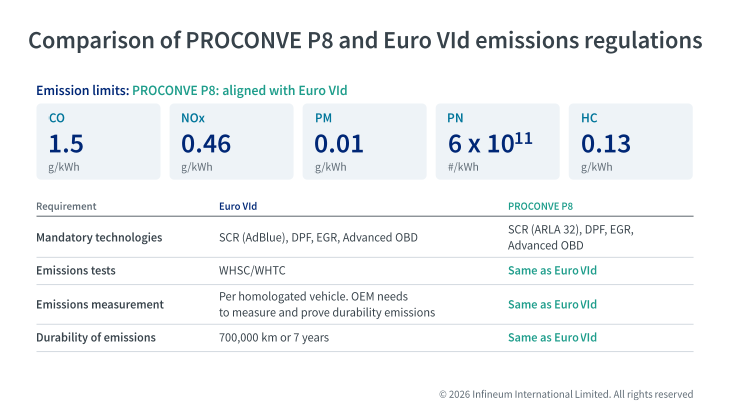
The PROCONVE (Programa de Controle da Poluição do Ar por Veículos Automotores) emissions standard was first introduced in 1986 and the P-Phase, which limits emissions from heavy-duty trucks has been progressively tightened. The latest PROCONVE P8 (P8) emissions standard, was phased in, becoming applicable to all new heavy-duty vehicles covered by the regulation from January 2023. It incorporates emissions limits and control requirements broadly aligned with Euro VI technology (Euro VId), including advanced onboard diagnostics (OBD), in-service conformity and real-driving emissions provisions.
However, with the average age of trucks in Brazil estimated to be over 12 years, fewer than half of the trucks on the roads meet P7 or the latest P8 emissions limits.
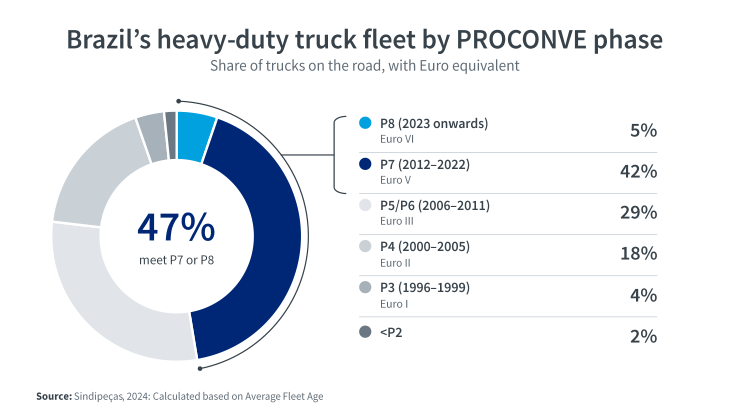
This slow roll over to the latest technology prompted the government to launch the Renovar program in 2022, a federal scrappage buyout intended to remove very old trucks from the road entirely.
The latest P8 emissions regulations require significant hardware changes such as the use of typical emissions-control technologies used to achieve compliance including diesel particulate filters (DPF), selective catalytic reduction (SCR) and exhaust gas recirculation (EGR).
In addition to exhaust aftertreatment systems (EATS), advanced OBD are needed to monitor hardware and emissions performance while additional sensors and engine management systems are used to ensure real-world compliance is maintained. The higher cost of P8 technology (an estimated R$100,000 premium per vehicle), prompted major agribusiness and truck fleets to pre-purchase P7 compliant trucks in late 2022, causing an artificial contraction in the heavy vehicle market in 2023.
The market recovered somewhat in 2024, but in 2025 heavy-duty truck sales fell by more than 20%, manly owing to high interest rates and constrained credit availability which made fleet renewal uneconomic for many operators.
From this relatively weak base, continued financing pressure and delayed fleet replacement means sales of heavy-duty trucks remain low in 2026. From January to August 2026, according to data from ANFAVEA, 70,650 trucks were registered vs 73,819 over the same period in 2025, down 4.3% overall. In response to falling production volumes the government introduced 'MOVE Brasil', a R$10 billion subsidised credit program to encourage fleet renewal. While this temporary measure has produced a noticeable recovery in registrations, it is unlikely to be enough to overcome the underlying financing and replacement-cycle headwinds.
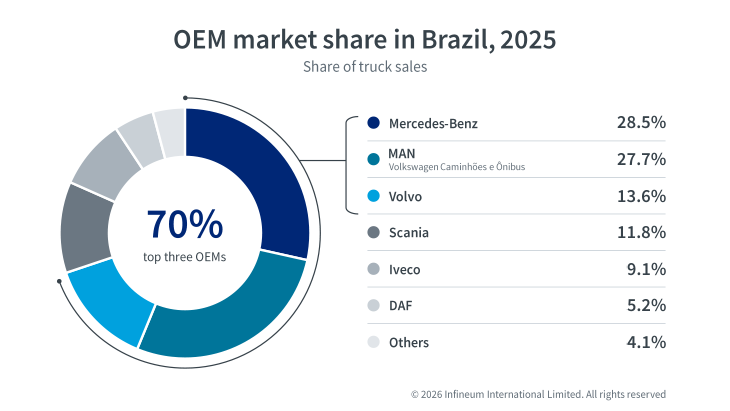
Three OEMs, Mercedes Benz, MAN and Volvo, hold a combined market share of 70% of the truck market in Brazil.
Despite mixed Q1 2026 sales results reported by heavy-duty vehicle manufacturers, many have announced considerable investments in Brazil amounting to some US$ 1.6 billion (approx. R$ 8.1 billion) from 2021 to 2029.
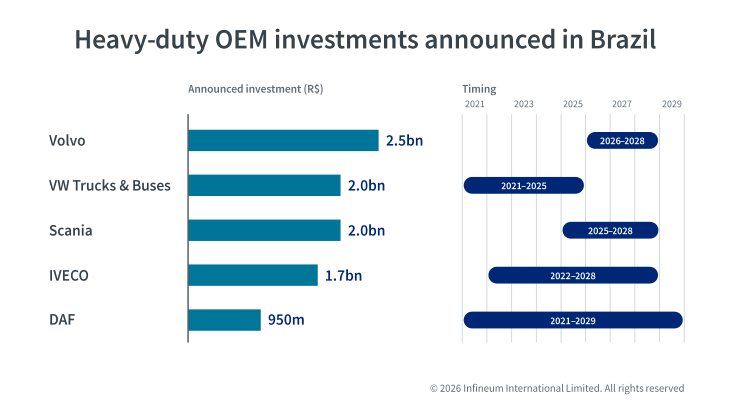
The main areas of investment include the modernisation and expansion of production facilities, increasing research and development capabilities, and supporting the transition toward sustainable, low emission technologies.
Decarbonisation of the transportation sector is becoming an increasingly important driver for change in the on-road commercial vehicle segment, which transports 62% of Brazil’s cargo. Brazil has updated its Nationally Determined Contribution (NDC) to the Paris Agreement, which establishes an economy-wide target of reducing net GHG emissions by between 59-67% below 2005 levels in 2035 and to achieve net zero emissions by 2050. In February 2026, Brazil published the country’s Climate Plan, providing the framework for its implementation.
Since Brazil has adopted a technology agnostic approach to decarbonisation, alternative fuels are expected to play a key role into the future.
To ensure the expansion of biofuels and strengthen their role as a tool to reduce GHG emissions in transport, the Brazilian government launched the National Biofuels Program, called RenovaBio, in December 2016.
More recently, the Fuels of the Future Law (nº 14.993/2024) has been introduced with the aim of decarbonising the transport sector through the use of sustainable fuels and the implementation of low carbon programs. The law proposes the integration between RenovaBio and other existing mobility decarbonisation programs and establishes blend mandates and annual targets for reducing GHG. Currently the law says the percentage of B100 (100% biofuel) to be blended into diesel fuels should increase by 1% annually to reach 20% (B20) by 2030, although this increase is subject to technical feasibility assessment.
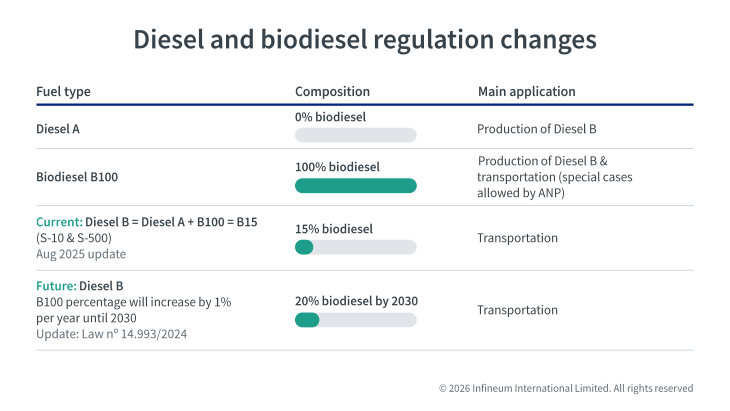
Note: Diesel B is available in two versions, one with 10 ppm Sulphur (S-10) and the other with 500 ppm Sulphur (S-500). Although S-10 is the mandatory limit by legislation, S-500 can still be found in some remote areas of the country.
According to sales data from the National Petroleum Agency (ANP), diesel and biodiesel represent about 48% of the fuel used by the transportation sector, followed by automotive gasoline at 26% and ethanol at 20%. Brazil currently mandates a B15 biodiesel blend in on-road diesel sold nationwide, and its use has been growing in recent years.
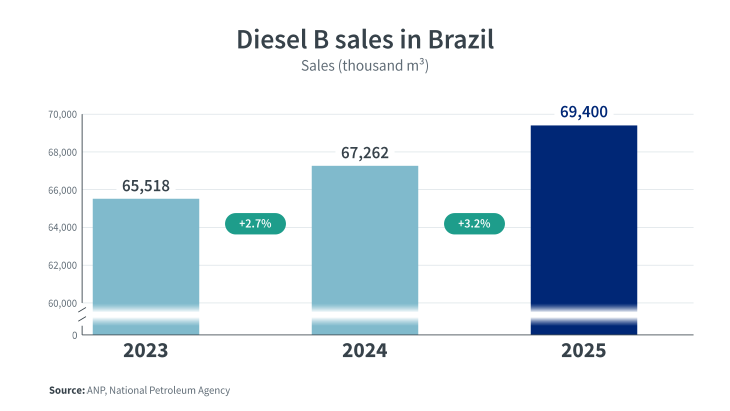
Updated regulations that prohibit biodiesel imports for on-road use and rising end user demand mean local biofuels production has also been growing. In 2025, Brazil produced more than 9.8 billion litres of biodiesel, an increase of 8.3% compared to 2024. For 2026, forecasts estimate total production of 10.2 billion litres, driven by growing diesel pool demand, despite the mandated blend rate remaining steady at B15.
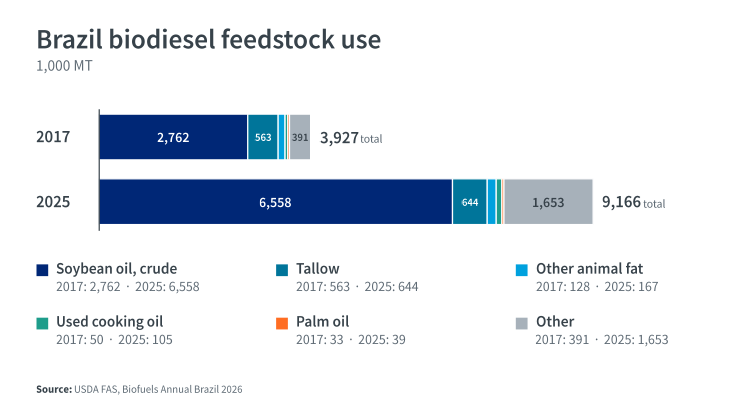
In 2025, The main feedstock used for biodiesel production in Brazil was soybean oil, with the use of tallow and other feedstocks increasing slowly.
The technical issues associated with the rising levels of biodiesel mandated by the regulation are broadly engine compatibility and ensuring higher biodiesel blends work reliably across the whole fleet. While P7 and P8 compliant trucks are generally designed to be biofuel compatible, as already noted, the heavy-duty vehicle fleet in Brazil includes many older trucks, which were designed to operate at lower biodiesel content. These concerns mean the move toward higher blend ratios is now subject to dedicated testing rather than simply being implemented annually.
In addition, fuel quality and stability both in the engine and during storage can be cause for concern. Biodiesel is more prone to degradation, sludge and particle formation, which means there may be a higher risk of filter clogging, failures in injection equipment and fuel pump systems, which could result in higher maintenance costs.
While the environmental benefits of increasing biodiesel use are evident, heavy-truck operators' priorities are centred around maximising payload, increasing utilisation and uptime while minimising total cost of ownership.
Since biodiesel has a lower energy content per litre than petroleum-diesel, higher biodiesel blends potentially come with a fuel economy penalty. In a tough market, even a small increase in fuel consumption and running costs can make a big difference to fleet operators’ bottom lines.
With these factors in mind, in 2026 Brazilian transport and fuel sector organisations jointly argued that the move above B15 needs extensive laboratory and field testing before the mandate is approved. In July 2026, authorities announced the start of the operational testing phase of the National Biodiesel Testing Program to evaluate the feasibility of biodiesel blends ranging from B16 up to B25, which is the maximum limit established under the Fuel of the Future Law. The Program involves R$30 million of investment over three years, which will fund laboratory testing, engine and vehicle analysis, and studies on fuel quality, performance, energy efficiency, and emissions.
Looking ahead, despite the concerns, it is thought that regulators may authorise the blend increase in 2027, and industry groups suggest that current technical and economic conditions support raising the blend directly to B17.
As Brazil moves towards higher biodiesel blend ratios, ensuring fuel quality and maintaining reliable engine operation will become increasingly important.
Infineum continues to develop and test lubricant additive technologies designed to address the challenges associated with higher biodiesel use, supporting the industry and helping heavy-duty vehicles maintain reliable performance in the field.
Sign up to receive monthly updates via email