Commercial vehicles
Managing water in H2ICE
26 May 2026
25 August 2026
Designing heavy-duty engine oil formulations to perform reliably as decarbonisation pathways diverge

As OEMs work to cut greenhouse gas emissions the global long-haul trucking industry is exploring a number of decarbonisation options. While diesel is forecast to remain the backbone of the heavy-duty fleet for many years, the mix of other low and zero carbon fuel options is expected to grow in the future. With this scenario unfolding, Adam Marsh, Infineum Principal Scientist, assesses the role of hydrogen internal combustion engines (H2ICE), explores their specific formulation requirements and looks at how, with such an uncertain future ahead, formulators need to be ready with both multi-fuel and bespoke lubricants to meet evolving OEM requirements.
Using hydrogen in an internal combustion engine (H2ICE) is one decarbonisation option currently being developed and tested by a number of heavy-duty vehicle OEMs. Engine oils for these H2ICE applications need a carefully designed additive strategy since hydrogen changes both the operating conditions and performance requirements. Unlike conventional fuels, hydrogen increases the risk of pre-ignition, where even very small quantities of oil vapour or fine droplets entering the combustion chamber can promote an ignition event before the spark. At the same time, hydrogen combustion generates substantially higher water levels that form emulsions in the lubricant, weakening hydrodynamic film formation and accelerating corrosion across key engine components.
Click to read our previous in-depth articles on minimising pre-ignition and managing water in H2ICE.
From a formulation standpoint, these hydrogen-specific requirements must be managed without compromising the core performance expected from modern heavy-duty lubricants.
Robust oxidation stability, antiwear protection, acid neutralisation and measurable fuel economy performance remain important. This is particularly true as OEMs and fleets drive towards lower total-cost-of-ownership and sustainability-linked performance metrics. On the flipside, unlike diesel and other carbon-based fuels, hydrogen combustion does not produce soot – removing a contaminant that leads to soot-induced thickening, surface abrasion and agglomeration phenomena. As a result, hydrogen engines do not require such high levels of dispersant additives that are typically needed in conventional heavy-duty engine oils.
A comparison of the difference in performance requirements between a lubricant optimised for diesel-fuelled applications and one designed primarily for H2ICE is shown below.
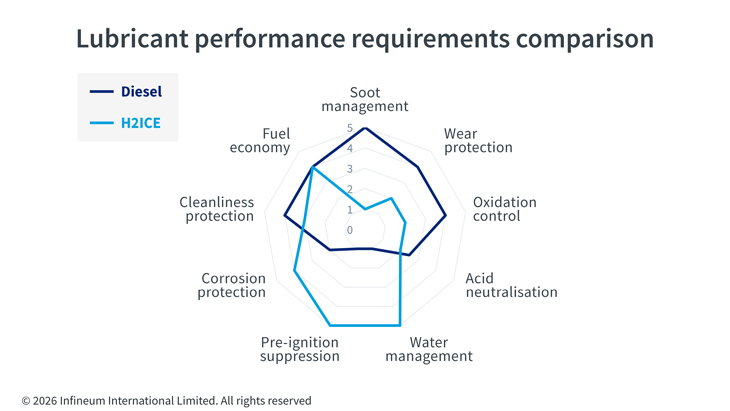
These revised requirements define the technical need: lubricants for hydrogen engines require careful formulation to ensure suppression of pre-ignition tendencies and manage water contamination. At the same time they must continue to deliver the efficiency and durability credentials that operators already expect from premium heavy-duty engine oils.
Lubricants for H2ICE have unique performance demands, but there are market-driven constraints that limit the near term viability of fully bespoke formulations for some of the heavy-duty market. For many OEMs, service network logistics favour multi-fuel-capable lubricants rather than hydrogen specific products. Heavy-duty hydrogen deployments remain small, relative to the diesel parc, and some OEMs may continue to prioritise workshop simplicity, where diesel will dominate for the foreseeable future. In addition, in a diesel-centric market, use of multi-fuel-capable oils in the service-fill market could help reduce the risk of misapplication of H2ICE oil into diesel engines.
At the same time, the durability requirements for lubricants used in H2ICE applications are still poorly defined. Research programmes on modified heavy-duty engines are just starting to generate structured durability data. However, significant gaps remain, particularly for high mileage, real‑world field performance.
The wide scale transition from multi-fuel-capable lubricants to bespoke hydrogen only formulations largely depends on two converging factors:
Sufficient fleet scale to justify dedicated products and distribution channels
Robust durability datasets demonstrating the in-field H2ICE requirements
At present, it is anticipated that both multi-fuel and bespoke lubricant solutions will be required in the future. However, the relative balance between these approaches remains uncertain.
Based on current industry trajectories, broader H2ICE adoption is expected in the early to mid 2030s with a critical mass most probable in the 2040 timeframe.
This suggests a phased transition, where multi-fuel-capable lubricant formulations dominate in the short term, with bespoke hydrogen lubricants becoming commercially justifiable only once H2ICE truck populations expand and long term durability requirements are established.
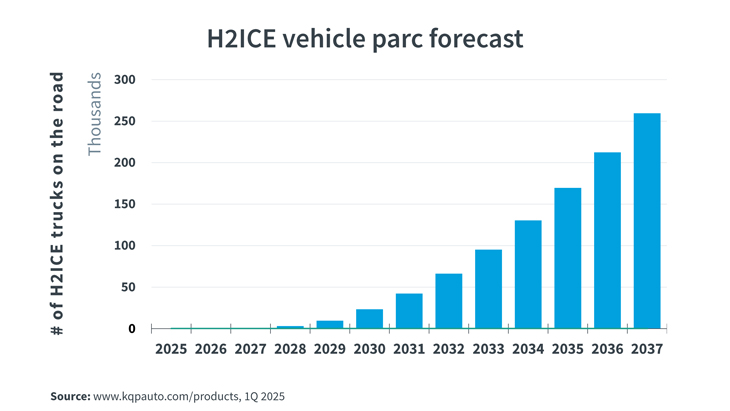
China is likely to be an early adopter of hydrogen in heavy-duty applications. Its targets include 40% new energy vehicle penetration in the heavy-duty truck market and a fleet of more than 1.6 million new-energy heavy trucks, carrying 18% of highway freight, by the end of the decade. Refuelling infrastructure is growing quickly, with 574 H2 stations already in operation by the end of 2025. Efforts to develop 30,000 km of zero-carbon highway transport corridors along major national expressways mean some 3,000 heavy-duty truck charging/swapping stations and hydrogen facilities are expected to form coordinated decarbonisation-enabling hubs. This rapid scaling up of new energy heavy-duty trucks, with hydrogen energy as one of the core technical pathways, means that what happens in China could be a very good long term indicator of the future road to heavy-duty vehicle decarbonisation – one we will continue to watch.
As the H2ICE market matures, formal lubricant specifications for hydrogen-capable technologies will inevitably emerge to address the established in-field appetite.
Some of the early-adopting OEMs are already advancing internal specification development for H2ICE. In addition, the European Automobile Manufacturers’ Association (ACEA) has asked the Coordinating European Council (CEC), which develops test methods for the performance testing of oils, to explore a hydrogen pre-ignition test and to support broader industry adoption. However, until specifications are formalised, it remains difficult to distinguish a lubricant that meets future performance thresholds from one that genuinely exceeds them for these well-defined tests, limits, and validation pathways.
As hydrogen engine technology evolves and matures, optimised lubricants based on real-world durability assessments and workshop requirements can be defined
As OEMs refine their expectations, requirements are likely to diverge based on regional service norms and market needs, power density targets, combustion strategies, and hardware severity. A formulation that clears the bar for one technology platform may be insufficient for another, while exceeding baseline limits can provide critical headroom for OEMs pursuing more aggressive duty cycles or next generation hardware architectures. This reinforces that performance validation and OEM approvals are not procedural formalities but the foundation for a credible benchmark in hydrogen-capable lubricants. Surpassing those benchmarks will increasingly define the difference between capable and optimised technologies.
Scenario work from industry experts and analysts consistently shows that emissions from heavy-duty trucks are hard to abate, which suggests a portfolio of technologies may be needed rather than a clean, linear shift to one winner. The global long-haul trucking industry is now moving into a multi-decade transition, where no single decarbonisation pathway is likely to dominate. Diesel is forecast to remain the backbone of the global fleet for some time, but it is expected to increasingly coexist with a mix of low and zero fuel carbon options. These include hydrogenated vegetable oil (HVO) and other advanced biofuels, natural and renewable gas, hybrid and battery electric trucks, as well as hydrogen in combustion engines and fuel cells. However, these different fuels are not all equal in terms of their emissions reduction capability, sustainability, ease of use in fleet operations, refuelling infrastructure availability, cost and maturity.
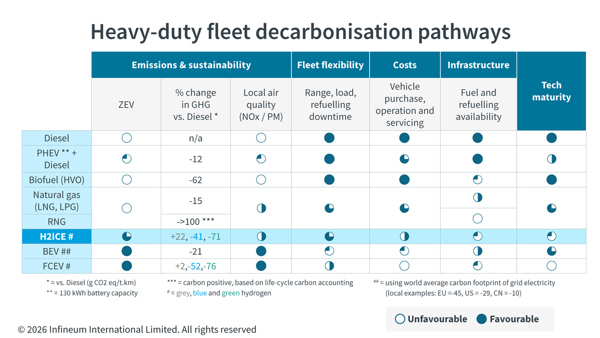
The result is a future market that is likely to be more divergent than today’s, with different technologies scaling at different speeds by region, duty cycle and use case. Even by 2050, most credible outlooks still show a mix of internal combustion and zero‑emission trucks on the road, rather than a fully homogeneous zero emission fleet.
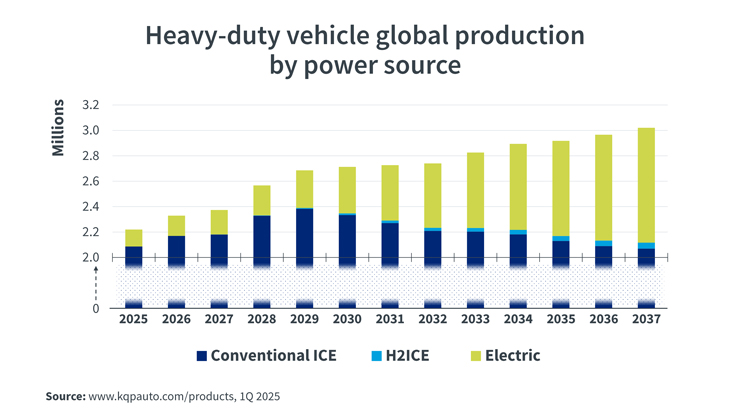
Heavy-duty OEMs are continuing to explore a wide range of lower and zero carbon energy sources as they work towards their net-zero goals. This means we can expect lubricant requirements to shift in distinct ways across the various fuel types since each powertrain introduces different chemical and thermal stresses. These various performance requirements will drive more tailored formulations, smarter additive optimisation and, in some cases, multi-fuel lubricant technologies engineered to perform reliably across several combustion environments.
Today, the heavy-duty H2ICE market is still taking shape, and its path to maturity remains anything but fixed.
What does seem clear is that, by being ready with both multi-fuel solutions and bespoke hydrogen formulations, it will be possible to meet evolving requirements as OEM strategies and customer needs crystallise.
Visit the Infineum Insight Information Hub to read more articles about alternative fuels.
Sign up to receive monthly updates via email