Alternative fuels
Looking beyond diesel
25 August 2026
26 May 2026
Hydrogen combustion engines present unexpected challenges for lubricant formulators

As global greenhouse gas emissions regulations continue to tighten and customers increasingly look for greener transportation solutions, the hydrogen internal combustion engine (H2ICE) is gaining momentum in both on- and off-highway heavy-duty applications. Christopher Soucy, Infineum Technologist, looks at the operating environment inside an H2ICE and assesses how this places new and unexpected demands on the engine oil.
Hydrogen internal combustion engines (H2ICE) are emerging as an important pathway for decarbonising both on- and off-highway heavy-duty applications, alongside other decarbonised powertrain solutions. Although the hardware may look very familiar, hydrogen combustion fundamentally changes the operating environment inside the engine, which introduces new challenges for the engine oil.
Water management is a well understood phenomenon in large engine applications, where the mechanical removal of water through the use of centrifugal separators is commonplace. However, in the heavy-duty vehicle segment such approaches are not practical nor economically viable. Hydrogen combustion produces more than four times the amount of water relative to diesel combustion, which can accumulate in the lubricant under certain duty cycles, especially when operating at low oil temperatures.
Robust water management is an essential part of any lubricant formulation for use in H2ICE.
Literature teaches us that water enters the oil predominately via moisture-rich blow by gases that pass over the piston rings during combustion. Further water accumulation can occur when these gases condense during engine shutdown and remain present in the crankcase and lubricant pathways upon cold start.
The rate and extent of water accumulation is strongly dependent on duty cycle. Short, low speed / low load operation promotes moisture build up, while sustained high temperature running enables water to be driven off. This means it is crucial to understand real‑world operation when defining suitable water management requirements for H2ICE applications.
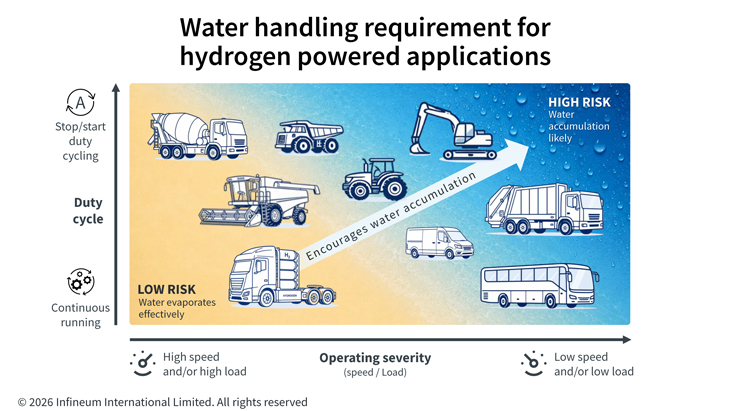
Duty cycle is a significant driver in encouraging water accumulation in particular applications
Engine oils can typically dissolve only a few hundred parts per million of water. Once this saturation limit is exceeded, water exists as dispersed droplets, forming water-in-oil emulsions. Maintaining a homogenous emulsion in these environments is critical because if the emulsion is unstable, water can separate to form a free aqueous layer at the bottom of the sump creating risk of hardware damage.
Infineum adapted a standard industry method, ASTM D7563, to assess emulsion stability, where the presence of any aqueous layer identifies oils with weaker performance. The industry test method has been modified to exclude the E85 fuel contaminant and was extended in test length to 168 hours. These conditions enable improved differentiation between lubricant formulations and allow optimised additive solutions to be identified.
As the figure below illustrates, oil formulations that remain as stable emulsions at 24 hours can separate, and even form aqueous layers, when the test is run over an extended timeframe.
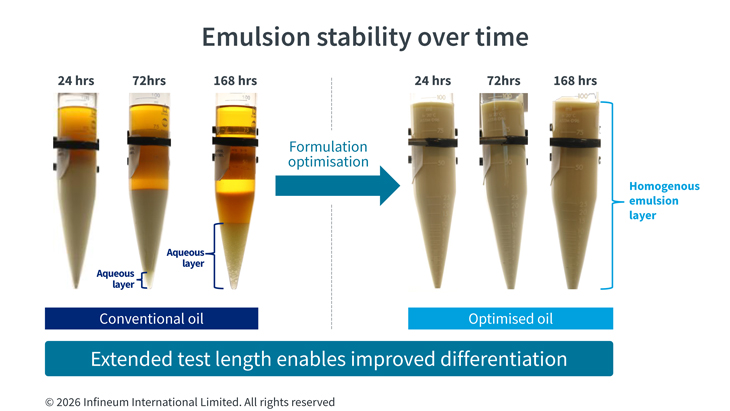
Oils for use in H2ICE applications can be optimised to maximise emulsion stability
The testing carried out has established that emulsion stability is highly formulation dependent. This reinforces the need for water handling assessments to be considered when selecting appropriate oils for use in H2ICE applications.
The impact of water exposure on oil robustness has been investigated. In our testing, 10% water was selected as being representative of extreme operating conditions. The notable increase in viscosity of the resulting water-in-oil emulsion, due to the formation of complex structural networks, was found to be reversible via water evaporation, with the viscosity returning to expected levels, equivalent to fresh oil.
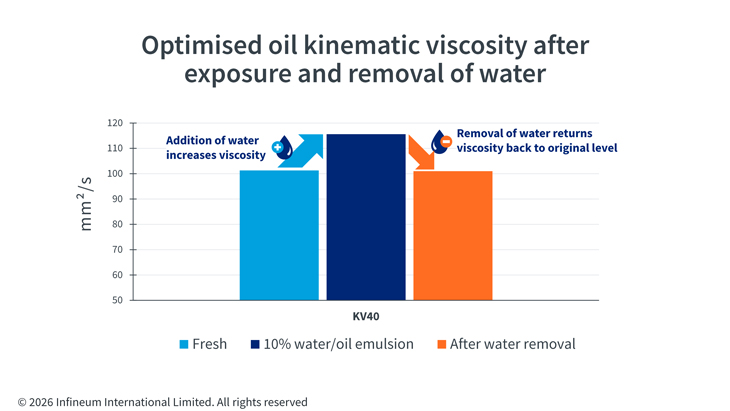
Oils optimised for emulsion stability retain viscometric properties after exposure then removal of 10% water
In addition, elemental composition and wear protection capabilities were assessed after removal of the water through Inductively Coupled Plasma testing (ASTM D5185) and a reciprocating mini traction machine (MTM-R), an in-house developed method that simulates wear performance on rolling-sliding contact areas in the engine. These results remained unchanged, which further reinforces that water exposure - even at high levels - does not inherently compromise lubricant integrity when the formulation is designed for H2ICE environments.
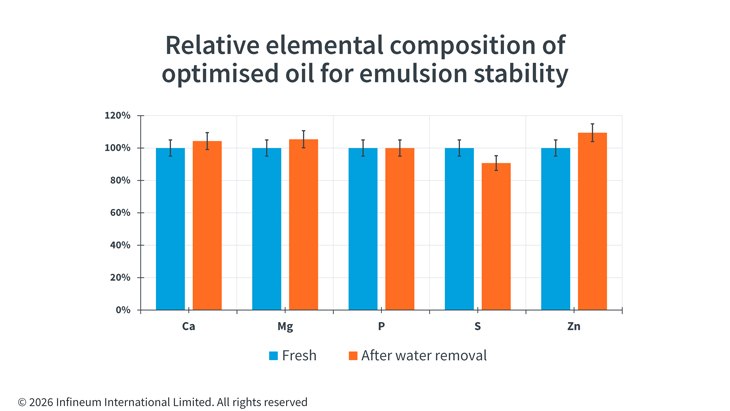
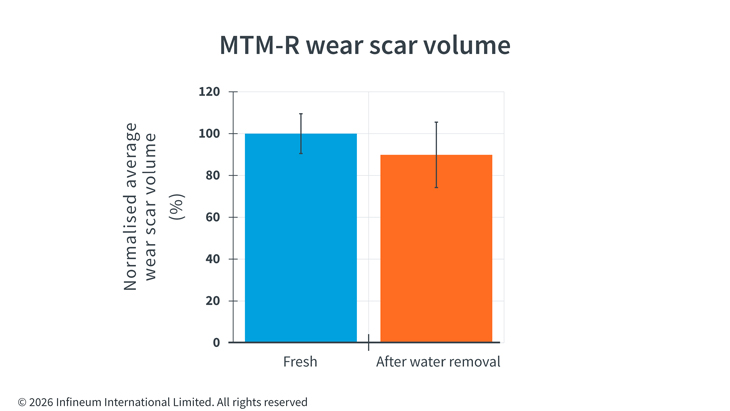
Oils optimised for emulsion stability can demonstrate robust formulation durability after exposure then removal of 10% water
Further experiments, where the lubricant was exposed to repeated wet–dry cycling, were completed to better mimic the most challenging duty cycles for water accumulation. Again, elemental and viscometric measurements confirmed that the lubricant could tolerate repeated cycles of emulsification and water removal without negative impact.
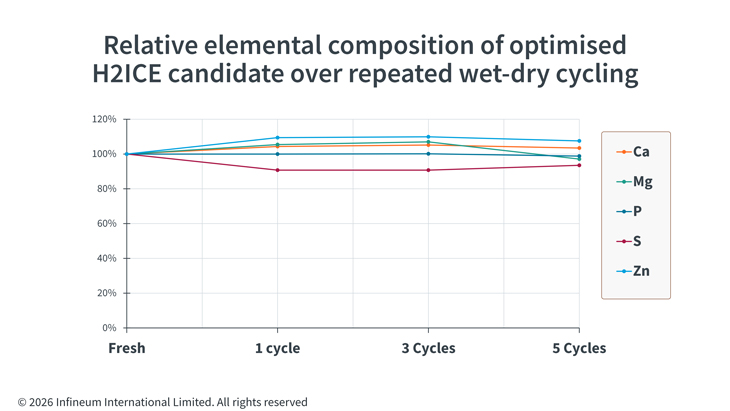
Oils demonstrated robust chemical durability after repeated wet-dry cycling with water
The increased presence of water as a result of hydrogen combustion increases the risk of corrosion within the engine. Exposure to moisture-rich blow by gases and oil containing water can accelerate corrosion of copper and ferrous surfaces, including bearing materials and piston bushings.
Standard copper corrosion tests developed for conventional fossil fuel applications have been found to show little sensitivity to this risk and can significantly under predict corrosion behaviour when water is present. Infineum used a modified high temperature corrosion bench test (HTCBT) method (ASTM D6954), which incorporates water to simulate the most extreme engine conditions that could be expected in H2ICE scenarios.
As illustrated in the figure below, the extent of copper corrosion is highly dependent on both the presence of water and lubricant formulation. A standard heavy-duty diesel (HDD) engine oil shows severe corrosion, despite offering acceptable protection under dry conditions. However, targeted formulation optimisation can significantly reduce corrosion under water-rich conditions.
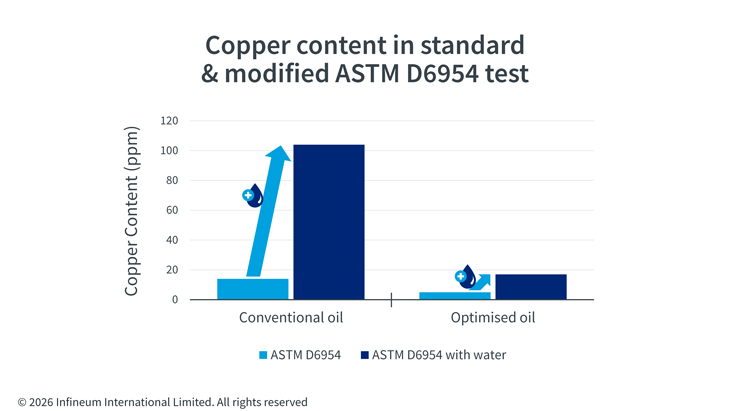
Oils optimised for copper corrosion protection can maintain excellent performance in high water environment
These tests underscore the necessity to assess lubricants for this characteristic when selecting oils for use in H2ICE applications.
Infineum used a modified ASTM 1748 test to simulate steel corrosion in a humid environment. Just as in the emulsion testing, test duration was extended (2 weeks vs 50 hours) to enable enhanced formulation differentiation. This has enabled Infineum to develop optimised oil formulations with excellent steel corrosion protection under these demanding conditions.
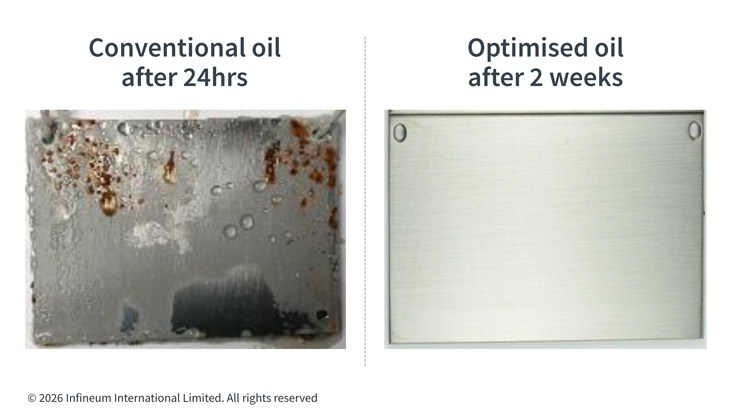
Oils optimised for steel corrosion protection can maintain excellent performance over extended periods
H2ICE is increasingly seen as part of the future technology mix for decarbonising the automotive sector. As its adoption grows, the role of the lubricant must evolve - as new challenges, such as pre‑ignition and water management, are added to established requirements for wear protection, oxidation control, cleanliness and durability.
Read our recent article on H2ICE pre-ignition here
Duty cycle and end use application strongly influence how water accumulates. But it is also clear that the lubricant must be able to manage the presence of additional water - maintaining stable emulsions and providing robust corrosion protection.
Through deep technical understanding, advanced assessment methods and targeted formulation optimisation, Infineum continues to develop capabilities to support customers as H2ICE hardware developments evolve - Formulating tomorrow together.
Sign up here to make sure you don’t miss the next Infineum Insight article where we will share more findings on H2ICE. Visit our Alternative Fuels knowledge hub for more information and be sure to follow Infineum Additives on LinkedIn.
Findings described are based on controlled and, in some cases, modified laboratory testing designed to simulate certain operating conditions. Performance may vary depending on formulation design and real‑world duty cycles.
Sign up to receive monthly updates via email