Driveline
Automotive gear oil challenges
26 May 2026
27 July 2026
New testing tools key in eliminating ‘forever chemicals’ from driveline formulations

Regulations designed to restrict the use of per- and polyfluoroalkyl substances (PFAS) have prompted the development of alternative chemistries for antifoam additives used in driveline fluids. Camille Herry, Infineum Head of Strategic Marketing – Enabling Electrification, talks about the challenges and explains how new testing tools have helped Infineum to transition to PFAS-free products, while maintaining equivalent technical performance and providing the supply continuity customers expect.
PFAS are a large class of thousands of synthetic chemicals that are used in a broad spectrum industrial processes and consumer products. They have unique and very desirable properties including heat resistance, chemical stability and the ability to repel water and oil. This means PFAS are used in a wide range of industrial applications including electronics, medical devices, firefighting equipment, food packaging, textiles, transportation and many more.
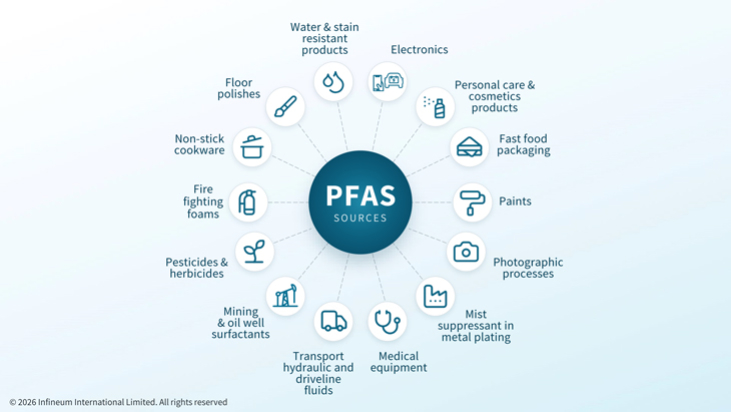
The strong carbon-fluorine bonds that makes PFAS so useful also mean that they resist degradation, which is why they are often called ‘forever chemicals’.
PFAS are known to persist and accumulate in the environment contaminating soil and water, making clean up technically difficult, energy intensive and costly. In addition, they are bioaccumulative chemicals, which means they build up in organisms faster than they can be eliminated. The European Chemicals Agency (ECHA) says certain PFAS are known to accumulate in people, animals and plants and cause toxic effects.
A new report from the European Commission estimates that if the current levels of PFAS pollution in Europe continue until 2050 without regulatory action, the cost will reach approximately €440 billion during that period. Tackling such PFAS releases at the source by 2040 would save €110 billion, whereas treating polluted water alone would cost more than €1 trillion.
Because PFAS contamination is seen as a threat to public health, wildlife and the quality of our natural environment, regulators have been restricting their use and broadening the number of these chemicals covered by regulations. The European Commission says that in the past 20 years, it has taken increasing action to tackle PFAS pollution and is committed to address the use of and contamination with PFAS under REACH, the EU's chemicals legislation, and other environmental and human health specific legislations.
The most harmful PFAS substances have already been banned for specific sectors and now the ECHA is assessing a universal PFAS restriction proposal. ECHA is targeting the end of 2026 for completion of their review of the restriction proposal and all comments submitted by stakeholders. This allows sufficient time for the European Commission to draw up and finalise the necessary regulation, a reasonable estimate for entry into force of the restriction could be around second quarter 2027. There would then be a derogation period allowed for specific sectors to enable PFAS substances to be substituted in products.
In the US, the Environmental Protection Agency (EPA) says it has taken significant action to reduce PFAS use in commerce, in coordination with federal partners and complementing significant efforts by several states. According to analysts, in 2025 nearly 350 PFAS bills were introduced across 39 US states. Looking at 2026, they suggest states can be expected to continue advancing ‘forever chemicals’ state laws, focusing on product bans, remediation requirements and public health studies as federal regulations shift.
In driveline fluids, PFAS-based fluorosilicone antifoam systems have typically been used to deliver aeration control. This is a critical performance requirement – particularly as driveline fluids trend towards ultra-low viscosities to support calls for improved fuel efficiency and electrification performance. In addition, it is vital to ensure aeration control when formulating next generation products for electrified vehicles. In these applications fluids operate at very high speeds (>20,000 rpm) and viscosities as low as 3–4 cSt KV100, which significantly increases the risk of air entrainment and associated performance loss.
While PFAS-based antifoams can provide the required level of performance in these applications, regulations limiting their use and potential future supply disruption means they need to be replaced. Infineum took the strategic decision to design-out these chemicals from driveline formulations to support evolving regulatory and sustainability expectations, while still delivering the technical performance customers expect.
Work on PFAS-free formulations began back in 2023, well ahead of the regulatory deadlines, and initially involved designing new tests and tools. In particular, the development of the High Speed Aeration Test (HSAT), which has now been recognised across the industry, was a key step in the project’s progress. This, novel methodology, capable of generating aeration conditions at speeds up to 25,000 rpm, represents a step-change in aeration assessment. The test provides a much closer simulation of real transmission conditions than the conventional ASTM D892/D6082 tests and has demonstrated correlation with the OEM-relevant transmission unit aeration test.
The next phase of the project involved a broad evaluation of PFAS-free antifoam technologies and an extensive screening of multiple candidates. Following a period of testing and validation Infineum selected an antifoam chemistry that provides:
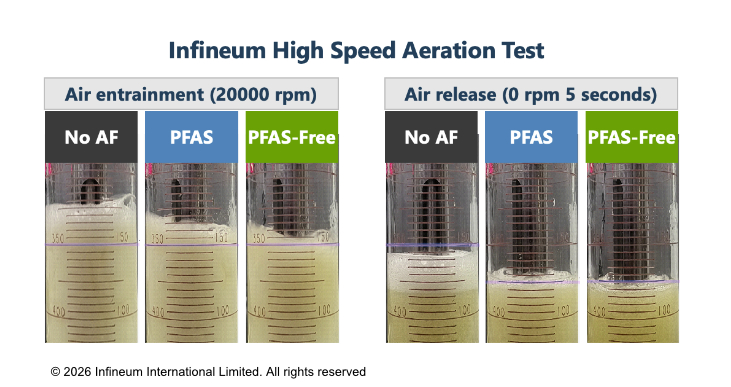
In testing, PFAS-free formulation demonstrates superior aeration control under high speed conditions
With a candidate chemistry identified and testing complete, work began to gain necessary OEM endorsements. Last year, transition planning was initiated for our customers alongside preparation for industrialisation and regulatory submissions.
All this activity means that today our driveline production has been successfully transitioned to PFAS-free antifoams.
By the end of 2026, PFAS-containing materials will no longer be handled in our blending sites and the rundown of legacy inventory has been initiated. Throughout this transition we remain committed to ensuring supply continuity to customers, who are themselves working to navigate increasing PFAS regulatory pressure.
This project is a good example of our ability to deliver ahead of regulatory requirement while maintaining technical excellence and customer focus. Being able to officially say that our plants have gone PFAS-free is not only a major achievement for Infineum but also a significant milestone for the entire chemical additives industry.
Read more about our advances in driveline testing here.
Sign up to receive monthly updates via email