Driveline
Engineering PFAS-free fluids
27 July 2026
26 May 2026
Efficiency gains, extended drain interval and thermal stability requirements drive demand for highly specialised fluids

Growing pressure from OEMs and end users for improved vehicle efficiency, longer drain intervals and improved performance is driving the development of advanced fluids. With OEMs looking for contributions from every part of the vehicle, these demands not only apply to engine oils but also to automotive gear oils (AGOs), which play a critical role in protecting a number of drivetrain components. Callum Sugden, Infineum Driveline Fluids Technologist, explores what OEMs expect from the latest generation of AGO products and the challenges that developing these complex fluids presents.
The automotive drivetrain is a group of key components that deliver the power generated by the internal combustion engine (ICE) or e-motor to the wheels, which comprise:
Transmission - attached to the engine and used to adjust drive shaft torque and speed.
Transfer case - attached to the transmission and used to adjust and split drive torque to the front and rear drive shafts in all-wheel drive and four-wheel drive vehicles.
Differential – connects the drive shaft to the drive axle and increases and splits drive shaft torque to the axles, while also allowing different wheel speeds.
Each component presents unique lubrication challenges and needs specific fluids, which means different fluids are required within each application. Within these components different gear types are used to perform various tasks including changing the torque, speed, and direction of the power source and each gear type has its own set of benefits and challenges.
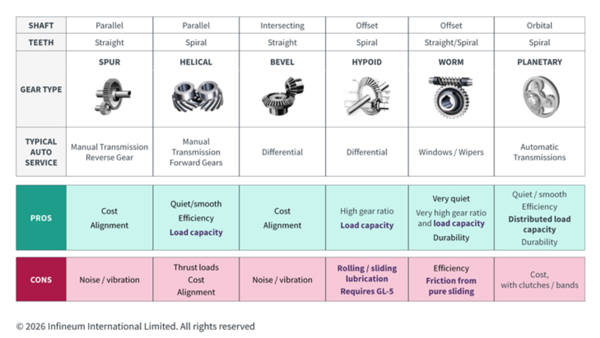
Oils used in these applications must provide strong wear protection while also ensuring efficient performance and compatibility with all relevant components in the system. AGOs are high performance lubricants designed specifically for manual transmissions, differentials, transaxles, and transfer cases across a wide range of vehicle types.
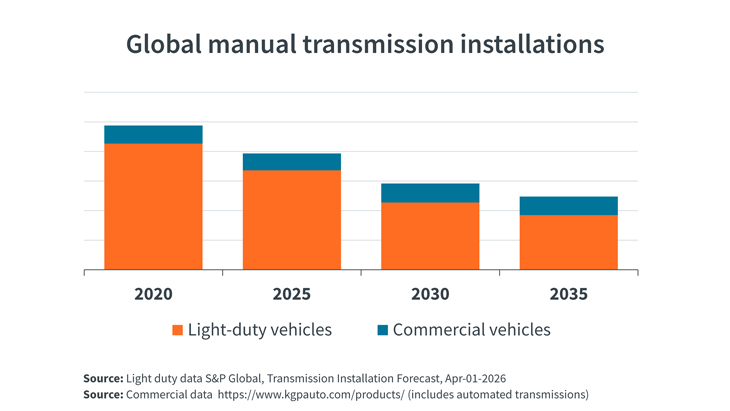
Looking at the market, the use of manual transmissions in light-duty vehicles is steadily declining as OEMs work to electrify these applications to meet greenhouse gas reduction targets. In commercial vehicles, including heavy-duty and medium-duty trucks, buses and coaches, the use of manual transmissions remains relatively flat. Out to 2035, forecasts suggest that more than 12 million vehicles produced may have a manual transmission installed.
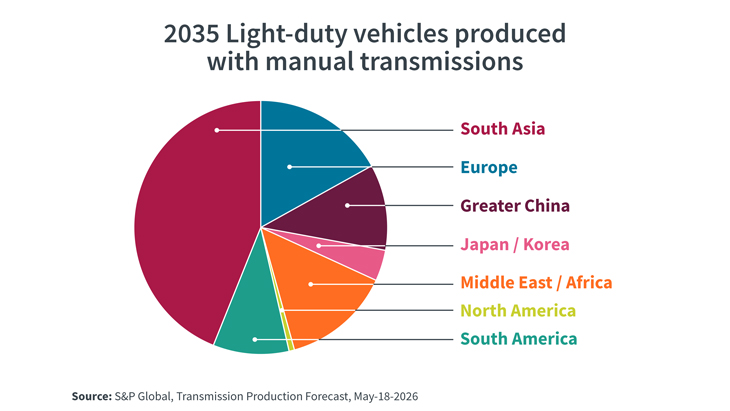
The 2035 forecast suggests South Asia could account for more than 40% of the production of light-duty vehicles with manual transmissions.
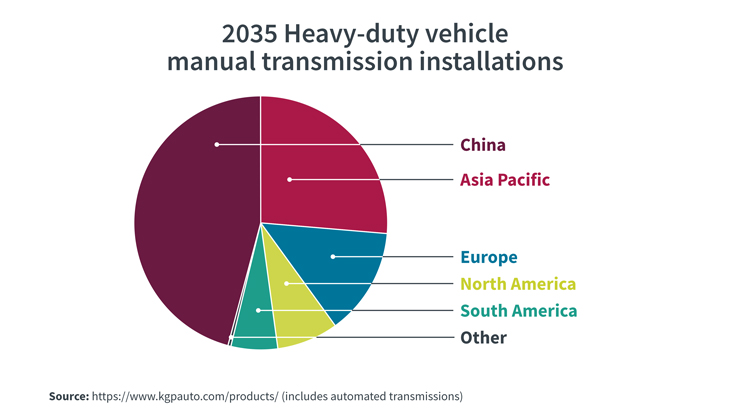
China is expected to continue to lead the installations of manual transmissions in commercial vehicles. And, by 2035, the whole Asia Pacific region is forecast to account for over 70% of manual transmission installations.
In a manual transmission, the driver selects the gear ratio using the shift lever. The forward gears are in constant mesh, with helical gears freely rotating on the shaft until they are locked to it by a synchronised dog clutch. Gear changes occur while the transmission is rotating, requiring the speed of the selected gear to be synchronised with the shaft before engagement. For reverse, a spur gear is typically used, with an idler gear inserted between the countershaft and the output shaft to reverse the direction of rotation. As this gear is generally not synchronised, the vehicle must be stationary before engaging reverse.
These operating modes result in high load transfer through a limited number of gear meshes, requiring lubricants formulated with extreme pressure (EP) and antiwear additives. Synchroniser performance depends on precise friction control achieved using friction modifiers, while low-temperature fluidity is critical for proper operation at the synchroniser cone interface. The lubricant must also be compatible with a wide range of materials and geometries.
The transfer case splits the power to the front and rear axles in four-wheel drive vehicles via two primary mechanisms:
Gear-driven - used in off-road utility vehicles is strong, but heavy and noisy.
Chain-driven - used in light-duty vehicles and passenger cars.
The differential allows the car to turn smoothly by letting the two wheels rotate at different speeds. This is necessary in a turn, because the outer wheel has to travel a longer distance than the inner one. Power from the driveshaft is transferred to the wheels through a pair of gears (pinion and ring gear), which change the direction of rotation and increase the force delivered to the wheels.
These gears operate under high loads and a mix of rolling and sliding contact, which makes lubrication critical. A high viscosity oil with EP additives is needed to protect the gears. Because EP additives are chemically reactive, they can also attack certain materials such as yellow metals or affect component durability. To manage this, the lubricant formulation includes additional additives to protect against corrosion, improve material compatibility, and ensure long-term reliability.
Limited slip differentials help maintain traction, especially in traction-limited conditions. Here the spinning of the wheel with less traction is limited via clutch packs, gears or a viscous coupling to increase torque to the wheel with more traction. In addition to EP additives, designs with clutch packs require friction modifiers, while those with a viscous coupling often use silicone-based oils.
AGOs are designed to help the drivetrain run smoothly and protect these vital components from wear and heat damage – preventing corrosion, scuffing, and pitting. Formulations must be able to withstand extreme pressures and friction, particularly in metal-on-metal contact zones where the heat and friction generated can cause wear and potential component failure.
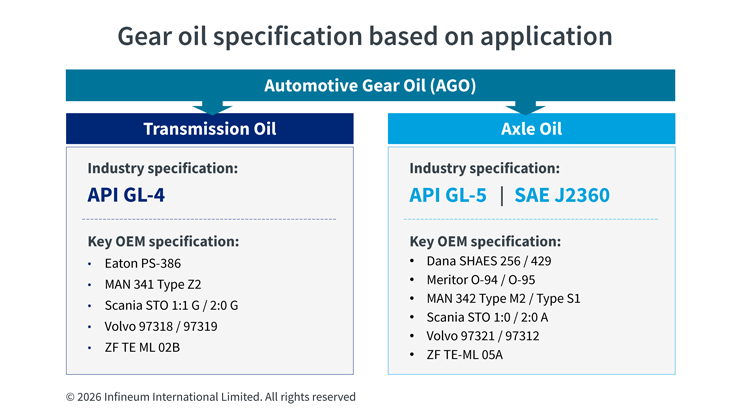
AGOs are formulated to a higher viscosity than conventional engine oils and follow the SAE J306 viscosity grading guide. The American Petroleum Institute (API) has set automotive gear oil specifications API GL-4 and GL-5, which are designed to ensure the required level of durability and performance is delivered to different automotive applications:
API GL-4 classifies passenger car and light truck manual transmission lubricants and oils used in tractor gearboxes and spiral bevel gear final drives and for manual transmissions, transaxles, and steering systems requiring moderate EP protection.
API GL-5 defines passenger car, light, and heavy truck and bus hypoid final drives where there is a large amount of sliding movement across the gears and non-synchronized transmissions and applications needing higher EP protection.
SAE J2360 is the global AGO standard, which combines most of the API GL-5 and MT-1 tests. It requires field testing and undergoes a formal approval process with the Lubricant Review Institute.
In addition to these industry requirements, some OEMs add their own in-house specifications, particularly where special warranty or extended lubricant service is offered. It is vital for formulators to have a comprehensive understanding of this complex certification landscape.
Some 70-80 percent of an AGO additive package formulation is made up from EP and antiwear additives, along with corrosion inhibitors, friction modifiers and other additives to enhance their protective capabilities.
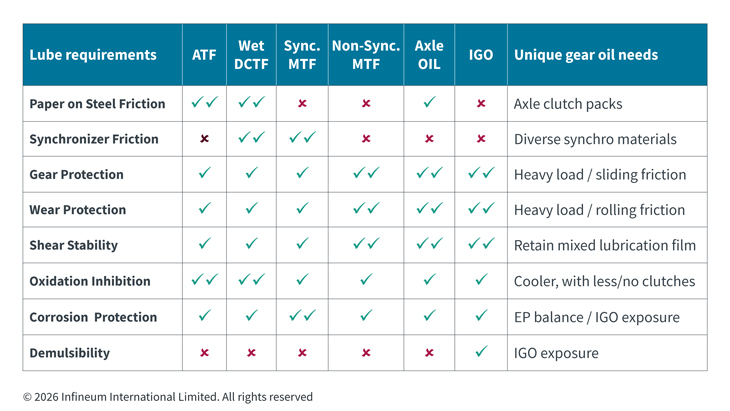
Gear oil applications are diverse, with unique lubrication requirements. Synchronised manual transmission fluids (MTF) must provide proper friction and corrosion protection characteristics, while non-synchronised MTF, axle and industrial gear oils provide EP protection.
Currently, monograde AGOs are used in the Latin America, Southeast Asia and South Asia regions, but the market is generally moving towards multigrades. And, as vehicle efficiency is becoming increasingly important to both OEMs and end users, there is a trend towards lower viscosity formulations. While SAE 80W-90 remains the predominant grade in the market followed by SAE 85W-140, demand for SAE 75W-90 and other SAE 75W-XX grades is growing. This move to lower viscosity grades means the demand for viscosity improver additives is likely to grow and there may be a shift to synthetic rather than mineral formulations, which makes securing the right base stock increasingly important.
OEM requirements for manual transmission and axle lubricants are evolving along three converging axes:
A continued shift toward lower viscosity grades to support drivetrain efficiency and CO₂ reduction targets.
Extended drain intervals, with some applications moving toward fill-for-life strategies, increasing the demand for long-term fluid durability.
Hardware evolution - including higher power density gearsets, more compact axle and transmission designs, along with reduced lubricant volumes and limited cooling, resulting in higher operating temperatures and increased churning conditions.
As a result, modern MTF and axle oils must be able to deliver a more demanding balance of performance, with particular emphasis on oxidation and thermal stability, gear protection under thinner films, and effective air management (foam control and rapid air release) to ensure durability and consistent operation over extended lifetimes.
What we are seeing is an increasingly complex market because, although API GL-5 and SAE J2360 dominate the market today, a proliferation of new OEM specifications is emerging. Right now, a clear understanding of the specification landscape and backward compatibility challenges are key differentiators for marketers when recommending the best fluid for each application and customer.
Fluid design is becoming more complex, with a stronger emphasis on durability, thermal stability, and air handling capability over time that can be demonstrated in extended field tests.
Gear oil formulation involves the use of low flash point components and odour-sensitive materials that impose constraints on blending and handling. This makes component choice, local supply, and manufacturing capability key enablers of consistent and scalable solutions. Infineum is actively addressing these dimensions to develop formulations designed to meet API GL‑5 and SAE J2360 performance requirements, while also working to provide robust regional supply chains and blending infrastructures.
Sign up to receive monthly updates via email