Fuels
Biodiesel use grows in Brazil
03 November 2026
03 November 2026
Advanced understanding of deposit formation is essential to help prevent operability issues with today's fuels

When today’s fuels, crude oils and additives create viscoelastic films, deposits that form at surface interfaces can behave very differently from those typically encountered in the past. Dewi Ballard, Infineum Product and Marketing Manager within Industry and Infrastructure, explains how gaining a better understanding of how these deposits form, by using appropriate techniques and careful interpretation, is becoming increasingly important to help prevent real-world operability issues.
Refiners, fuel suppliers and vessel operators are facing increasing pressure to maximise efficiency, reduce downtime and operate reliably with increasingly diverse feedstocks and fuels. While challenges include anything from crude oil fouling, asphaltene deposition, unstable marine fuels, biofuel blending and future fuel adoption, there is a common theme - materials interact with surfaces. And, understanding what is happening at these interfaces is critical to ensure real-world operability issues are avoided.
Measuring deposit formation is more complicated than it sounds and advanced surface measurements are needed to understand fouling, deposits and additive performance.
Infineum has been exploring advanced analytical techniques to better understand how deposits form and how additives interact with surfaces. This work has revealed that interpreting the results can be significantly more complex than simply measuring how much material has been deposited.
Many operational issues begin with the formation of deposits at surface interfaces. These deposits may reduce heat transfer efficiency, increase pressure drop, cause equipment fouling, stabilise emulsions, block filtration systems or promote sludge formation. In marine fuels, for example, excessive sediment can impair separators and filters. In crude oil production and processing, asphaltene deposition can affect equipment performance from production through to refining.
The challenge is that these deposits rarely behave as simple solid materials. They are often complex mixtures containing asphaltenes, resins, polymers, dispersants and other surface-active species that continuously change structure during adsorption.
Infineum has been using quartz crystal microbalance with dissipation (QCM-D), which is a highly sensitive technique capable of detecting nanogram-scale changes at surfaces. A thin quartz crystal is oscillated at a known frequency and, as material deposits onto the surface, the oscillation frequency changes. For simple rigid deposits, the change in frequency can be related directly to deposited mass using the well known and widely used Sauerbrey relationship. This sensitivity makes QCM-D attractive for studying adsorption phenomena that would be impossible to detect using conventional gravimetric methods.
Because measurements are made in real time, researchers can observe how quickly a material deposits, whether equilibrium is reached and how additives influence the adsorption process.
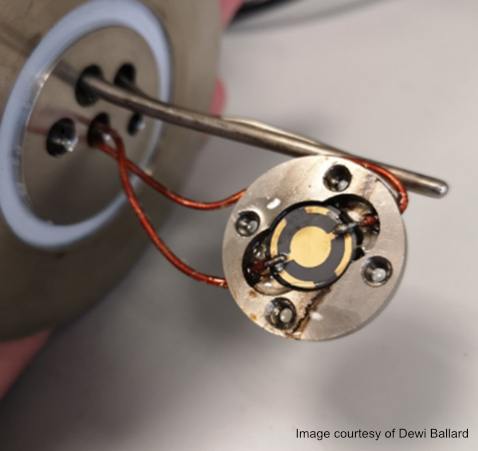
Custom built QCM-D with asphaltene deposit
The simplicity of the Sauerbrey equation has made it one of the most widely used approaches for interpreting QCM-D data. However, it has its limitations. The main issue is that the Sauerbrey's relationship assumes that the deposited layer is thin, rigid and mechanically coupled to the crystal surface, which in many real industrial systems is not necessarily valid.
Asphaltenes, polymeric additives, dispersants and other surface-active molecules can form films that behave less like rigid solids and more like soft viscoelastic materials. Such layers can trap solvent, deform during oscillation and dissipate energy within the film. When this happens, frequency changes no longer represent mass alone.
When polymers and additives create viscoelastic films Sauerbrey is not sufficient to measure deposit formation at surfaces.
The same apparent mass signal can arise from very different film structures and mechanical properties. This is particularly important when evaluating additive performance, as an additive may alter the nature of the deposited layer rather than simply increasing or decreasing total deposited material.
Along with frequency, modern QCM instruments often measure dissipation, providing information about how much energy is lost during oscillation. This gives an insight into whether a deposited layer behaves as a rigid film or a soft viscoelastic structure. By analysing frequency and dissipation together, a more complete understanding of the deposited layer can be developed. For example, two formulations that show similar apparent deposition levels may form films with dramatically different mechanical properties. One may create a compact, tightly bound layer while the other could form a highly hydrated, loosely bound structure. Without considering dissipation and appropriate modelling, these systems could appear deceptively similar.
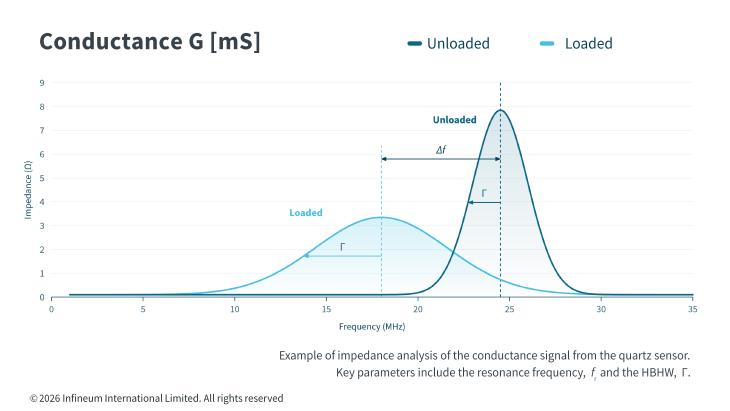
Trace showing dissipation (thickness of the peak) and the shift in frequency
Although no single technique provides a complete picture of interfacial behaviour, QCM-D is particularly valuable because it offers:
However, QCM-D is not a direct imaging technique and cannot by itself identify molecular structures. For this reason it is often complemented by techniques such as microscopy, interfacial tension measurements, spectroscopy or particle size analysis. At Infineum, QCM-D results are frequently considered alongside broader characterisation methods to build a more complete picture of surface interactions.
Our investigations have reinforced a simple but important lesson: understanding industrial fouling problems requires an analysis of the fundamental nature of the depositing layers. Research conducted on asphaltene adsorption has shown that relatively small fractions of surface-active material can exert a disproportionate influence on interfacial behaviour. Changes in molecular structure, heteroatom content and aggregation state can all affect how materials adsorb and organise at interfaces.
Similarly, when additives are introduced, the observed response may reflect changes in layer structure, rigidity or solvent incorporation rather than a straightforward increase or decrease in deposited mass. This means care must be taken when comparing formulations or predicting field performance from laboratory measurements alone.
In our experience, customers are ultimately interested in operability – keeping equipment running reliably for longer periods. This means a laboratory result is only valuable if it helps predict what may happen in a refinery, on a vessel or in a production system. This is one reason why Infineum places significant emphasis on connecting analytical measurements with real-world performance. Surface-sensitive techniques such as QCM-D provide valuable insights into adsorption mechanisms, but these results must always be considered alongside broader experimental and field evidence.
By building connections between laboratory understanding and operational experience, we can develop a more robust understanding of the factors that drive deposition and fouling.
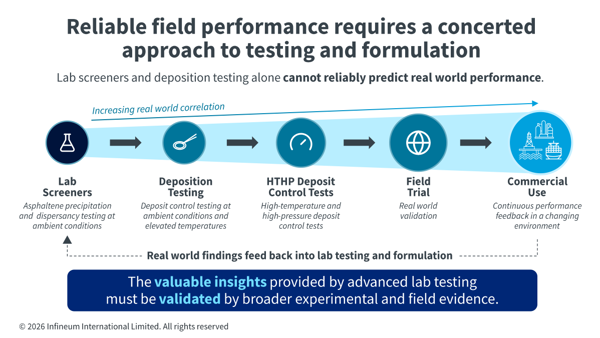
As feedstocks diversify and additive chemistries become increasingly sophisticated, understanding interfacial behaviour will become even more important. Future developments are likely to place greater emphasis on combining multiple analytical techniques, improving viscoelastic modelling approaches and strengthening links between laboratory measurements and field outcomes.
At Infineum, we continue to explore how advanced surface-science techniques can be used to provide deeper insights into deposition processes and to support the development of additives designed to improve reliability, efficiency and operability across the energy value chain. Because when it comes to surface deposits, measuring mass is only part of the story.
Sign up to receive monthly updates via email