Fuels
India’s ethanol journey
29 September 2026
29 September 2026
Field testing demonstrates how important diesel fuel operability is in maintaining performance and reliability in all conditions

Despite significant advances in diesel fuel quality, vehicle technology and additive chemistry, reliable winter performance still cannot be guaranteed by specification tests alone. Chris Stubbs, Infineum Industry and Infrastructure Product Manager, explains the learnings Infineum has gained from millions of operating hours across global fuel markets about how wax settling and fuel system behaviour can impact winter performance, and shows how understanding these effects is helping to ensure vehicles continue to operate reliably at the lowest temperatures.
In recent years, the lower number of winter diesel fuel operability incidents reported could suggest operability is not now a major concern. However, a single night of unusually low temperatures can still leave vehicles unable to start or operate reliably, creating significant disruption for fleets and end users. In recent cold European winters, real-world field problems have been observed, which have highlighted just how important fuel operability is to ensure performance and reliability are maintained.
Fuel operability is the ability of diesel fuel to flow and perform reliably in a vehicle under real-world operating conditions. Operability failures typically manifest as startability or driveability issues and can occur even when fuels meet their regulatory specification. Cold filter plugging point (CFPP) is generally a good predictor of operability for fuels where the gap between CFPP and cloud point is less than 10°C. However, when this gap exceeds 10°C, CFPP alone may not adequately predict vehicle performance, and further testing may be required to confirm operability. In such cases, the behaviour and location of wax within the fuel system can be as important as wax crystal formation alone.
Several industry trends suggest operability remains an important consideration today:
Ageing vehicle fleets. According to ACEA, passenger cars in the European Union are on average 12.3 years old, and the proportion of older vehicles on the road is rising. These older vehicles may be more susceptible to cold flow issues in the event of a reduced focus on operability.
Cold weather events. Extreme cold weather events continue to occur despite broader warming trends. In 2026, Europe recorded its coldest January since 2010. Freezing conditions extended across Siberia and northern and eastern Europe to parts of the US resulting in average land temperatures below the 1991-2020 norm.
Diesel supply. Modern diesel fuel supply chains increasingly rely on imports and blending flexibility, making robust operability performance more important than ever.
For fuel suppliers, preventing one operability issue is often worth far more than the cost of additional assurance testing.
Traditional cold flow discussions focus on wax crystal size and filterability. However, vehicle failures may occur because wax settles within the fuel system, restricting fuel flow and eventually causing filter blockage.
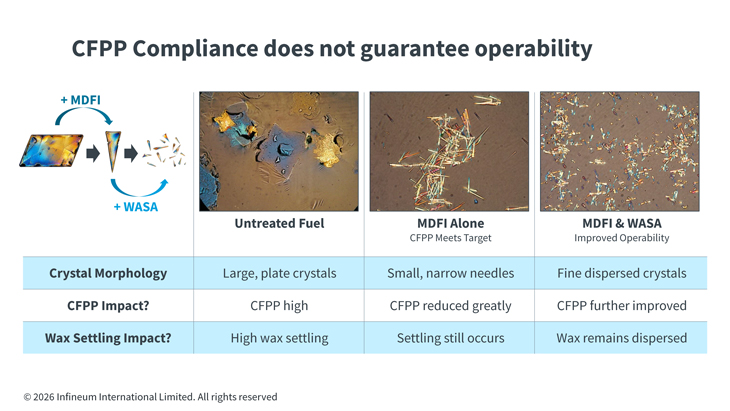
As demonstrated by microscopy and laboratory testing, fuels treated with Middle Distillate Flow Improver (MDFI) additives alone can achieve excellent CFPP performance while still exhibiting wax settling. The addition of a wax anti-settling additive (WASA) can help to keep wax dispersed throughout the fuel, reducing operability risks.
One of the most important lessons from operability research is that CFPP is generally a good predictor of vehicle operability when the gap between CFPP and cloud point is less than 10°C. When the gap exceeds 10°C, however, compliance with the CFPP specification alone may not translate into reliable vehicle performance, and further testing may be required to confirm operability. Testing across multiple evaluation methods has identified cases where fuels with similar, or even increased, CFPP values delivered significantly better operability performance due to improved wax management. This highlights the limitation of relying solely on CFPP to predict real-world performance under more severe conditions.
The most realistic measure of operability requires testing in vehicles under genuine winter conditions.
In Infineum's 2026 Japanese field trial conducted near Asahikawa, Hokkaido, fuels containing both MDFI and WASA maintained operability approximately 2°C lower than fuels treated with MDFI alone. Although 2°C may seem small, it can represent the difference between a vehicle operating normally or failing to start on the coldest morning of the year. While field trials provide the most representative measure of operability, the fact that they are often expensive and limited by the weather conditions at a specific location and time of year, lead to the development of the Cold Chamber Chassis Dynamometer (CCCD) test.
CCCD testing allows specific temperatures to be evaluated, at any time of year, whilst maintaining the real-world applicability of testing in a complete vehicle. Infineum carried out testing in a diesel Ford Focus, which uses a Ford variant of the popular DV6 engine. This engine was adopted by several manufacturers, resulting in multiple engine variants, and we believe it is a good representation of a vehicle commonly observed on the roads of Europe today.
When the same fuels were evaluated in CCCD testing, the addition of WASA delivered up to 6°C additional operability performance. Remarkably, this improvement was maintained even when MDFI treat rates were reduced.
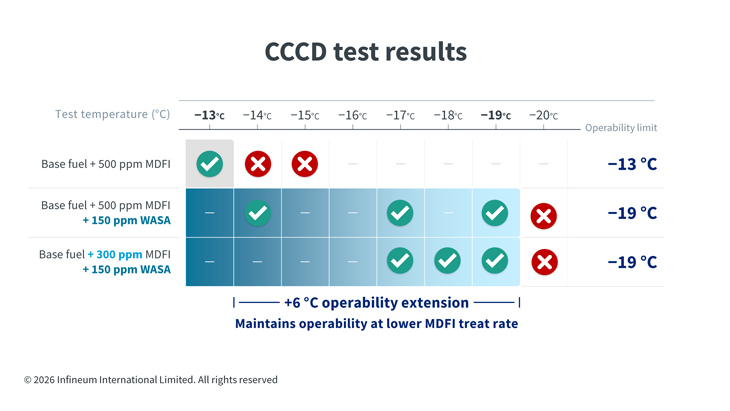
These results suggest that wax management, not simply CFPP performance, is increasingly important as test conditions become more severe.
Field trials and vehicle testing are expensive, time-consuming and require specialised testing equipment, which is not commonly available. They are best used to validate operability mechanisms rather than for routine fuel assurance.
For refiners and fuel producers, the practical need is a laboratory test that can identify the risk factors more efficiently.
Laboratory-based wax settling testing is currently widely used across Northern and Central Europe, Korea and Canada to support regional operability evaluation. Each region has its own climate conditions, fuel qualities and specifications, so use very different wax settling methods to best suit operability needs. For example, Europe tends to favour faster cooling, whereas Korea and Canada prefer slower cooling wax settling tests.
Laboratory testing can be used to assess the tendency of wax crystals in diesel fuel to settle during cold storage. In general, wax settling laboratory tests measure the cloud point of the lower portion of a fuel sample after controlled cold conditioning and compare it with the cloud point of the original fuel. An increase in the cloud point of the bottom fraction indicates that wax has become concentrated in this layer, providing evidence of wax enrichment and wax settling. As such, laboratory testing can determine a fuel's ability to maintain a uniform dispersion of wax crystals at low temperatures and is widely used to evaluate the effectiveness of cold flow improvers and wax anti-settling additives. A small or negligible cloud point increase suggests good wax dispersion and a lower risk of filter plugging, whereas a significant increase indicates a greater likelihood of wax settling, fuel starvation and poor cold-weather operability.
In addition to the measured cloud point shift, results can be incorporated into empirical operability algorithms that relate the degree of wax enrichment to the expected risk of fuel system restriction under field conditions. By combining wax settling behaviour with other low temperature fuel characteristics, these algorithms provide a more realistic prediction of winter operability than filterability tests alone.
While no single laboratory test perfectly predicts vehicle operability, specific laboratory testing focused on evaluating wax settling provides an effective and economical method for identifying potential risk when used in conjunction with the CFPP test, providing reassurance to refiners and fuel producers.
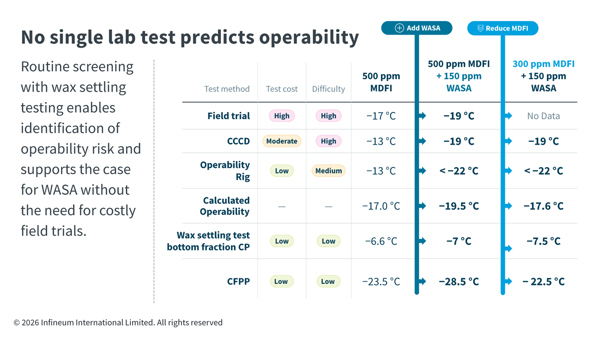
Our aim is not to suggest that refiners and fuel producers need to undertake field trials, CCCD testing or rig testing as part of routine assurance. These methods are valuable for demonstrating operability performance, but they are costly, complex and often impractical for regular fuel screening.
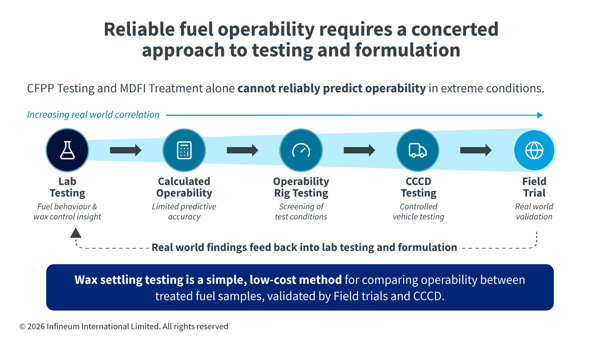
Laboratory operability tests offer a more practical way to discriminate between fuels by assessing wax settling behaviour, providing an efficient indication of operability risk without the need for more intensive vehicle- or rig-based testing.
Used alongside routine CFPP compliance, wax settling tests can provide refiners with a cost-effective and accessible screening tool, helping them to identify fuels that may need improved wax management before they reach the market.
Despite advances in fuel quality and engine technology, diesel fuel operability remains a critical aspect of winter performance. When significant CFPP depression is required, the challenge is not to simply achieve a target CFPP; it is to ensure fuel continues to flow reliably when vehicles encounter their coldest operating conditions.
Field trials, vehicle testing and laboratory studies all point to the same conclusion: effective operability requires both crystal control and wax management.
By combining MDFI technology with WASA chemistry and using appropriate screening tools, fuel suppliers can achieve greater confidence that specification compliance translates into real-world performance.
Sign up to receive monthly updates via email