Fuels
Diesel fuel operability matters
29 September 2026
29 September 2026
Ethanol quality, vehicle and infrastructure availability and consumer acceptance key to India’s flex-fuel future

To support its net zero ambitions, India is transitioning from conventional fossil fuels to low and zero carbon energy sources - one of the most significant changes to the country's road-transport system in recent decades. As government support for ethanol use makes it a more viable alternative fuel, Jeenal Patel, Infineum Industry Liaison Manager, looks at the evolution from 5% ethanol (E5) blending to today’s nationwide E20, explores consumer concerns and future ethanol trends and examines the learnings India could take from the extensive experience of ethanol use in Brazil.
India’s ethanol journey starts with a growing interest from the Indian government in pursuing ethanol as a part of the lower carbon fuel mix for transport applications, mainly driven by three key issues:
Improved energy security. India imports a large proportion of its crude oil, exposing the economy to international oil prices, geopolitical disruptions and exchange-rate movements. Replacing a portion of petroleum-derived gasoline with domestically produced ethanol reduces this exposure.
Support for agricultural economics. Ethanol creates new markets for sugarcane, maize and other feedstocks and could help to stabilise agricultural prices. In addition, it could help promote distilleries and bio-refineries, while creating new employment opportunities in the agricultural and processing sectors.
Environmental benefits. Ethanol use not only reduces carbon monoxide, hydrocarbon and particulate emissions, but can also reduce the lifecycle carbon intensity of transport fuel.
“One crore* litre of ethanol blended petrol can save around 20,000 tons of carbon dioxide emissions.”Ministry of Petroleum and Natural Gas, *1 crore = 10 million
However, the magnitude of the environmental benefit depends heavily on the feedstock, agricultural practices, processing energy and logistics.
All three of these key factors are helping to drive the increased use of ethanol in India’s transportation sector.
Ethanol use in India began some 25 years ago, with small pilot E5 projects. Following these trials, the Ethanol Blended Petrol (EBP) Programme was formally introduced from January 2003, initially targeting 5% ethanol blending in selected states.
From 2006 to 2013, although the E5 programme expanded into more states and Union Territories, progress remained slow, with average blending below 2%, due to limited ethanol availability, regulatory hurdles and pricing issues. The turning point came after 2014, when the government introduced administered pricing, assured ethanol procurement and progressively widened the range of permitted feedstocks. Ethanol was no longer dependent primarily on C-molasses, as B-heavy molasses, sugar syrup, sugarcane juice, maize, surplus rice and other grain feedstocks increasingly became part of the supply strategy.
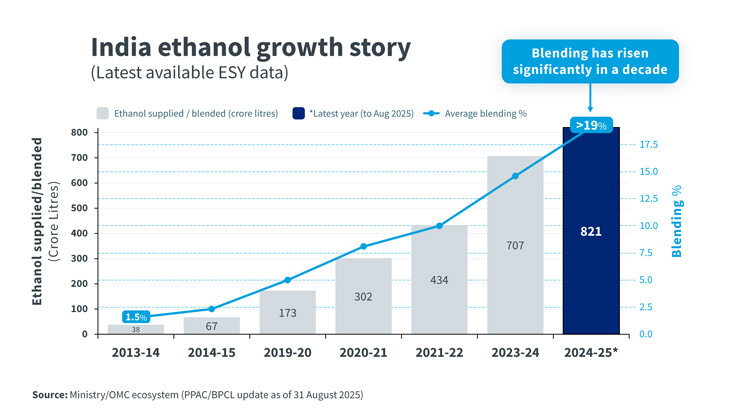
The National Policy on Biofuels, introduced in 2018 gave the programme a much more ambitious trajectory, with ethanol blending increasing from around 1.5% in 2013/14 to 10% by 2022. The original target of reaching E20 by 2030 was advanced to 2025. Since the E20 rollout, which started in phases from 2023, E20 petrol has now become the standard fuel sold across retail outlets nationwide across India - several years ahead of schedule. In support, ethanol procurement has grown from 38 to more than 820 crore litres, driven by government support, feedstock diversification and enhanced distillation.
Ethanol production capacity targets were set in the original National Institution for Transforming India (NITI Aayog) roadmap including:
Recent industry reports indicate production capacity has continued to expand, exceeding these roadmap levels in order to support nationwide E20 availability.
However, ethanol use is not without its challenges. Its lower energy density means its use comes with a fuel economy penalty. The typical mileage reductions for 4-wheelers is reported to be 5-7% and for 2-wheelers 3-4% - although this can largely be recovered through dedicated E20 engine calibration.
Other concerns are centred mainly around feedstock production and infrastructure. Developing feedstocks that do not directly compete with food markets including maize and non-food biomass will help improve the sustainability profile of ethanol while creating an additional use for agricultural waste. In addition, strengthening the entire fuel supply chain, from ethanol production through transportation logistics, storage availability, quality control and retail dispensing infrastructure will be essential.
As the government works to overcome production, supply and quality issues, a whole raft of concerns are being expressed by consumers across social media platforms.
First is a fear of fuel system failure. However, to date, there has been no rise in reported hardware issues linked directly to E20 use – although long-term impacts remain uncertain since India has only recently moved to E20. A second issue being voiced is the real fuel economy penalty. With E20 no cheaper to buy at the pump than conventional petrol, its lower energy per litre means users are likely to experience a measurable reduction in miles travelled per gallon – with some evidence that this fuel economy penalty may be larger than official estimates.
Vehicles in Brazil have been running on E20 and higher ethanol blends for roughly five decades, making it the world's strongest real-world reference case.
Over this time there have been no widespread ethanol-related engine failures in older carburetted vehicles, modern flex-fuel models or premium brands including Ferrari, Lamborghini and Porsche. And this continues, despite the fact that E32 is now available nationwide. Experience shows that major hardware, including fuel injectors, pumps and valves, is at low risk of damage provided fuel quality remains within specification - here Infineum additives can help with lubricity and corrosion issues. However, if any long-term impact occurs in older, non-E20-compliant vehicles, it is more likely to involve softer fuel system components including the fuel hoses, gaskets, O-rings and rubber seals that can perish.
That said, since E20 requires more fuel to achieve the correct air-fuel ratio, older fuel injected engines may occasionally reach the limit of their calibration range and trigger a check-engine light. This is not the case for modern electronically controlled engines that usually compensate for E20 use automatically.
One of the biggest concerns for ethanol containing fuels may be chloride contamination, which can accelerate the corrosion of fuel-system components.
Recent concerns voiced by the Society of Indian Automobile Manufacturers (SIAM) were not related to the ethanol blending ratio but were rather linked to chloride contamination. While in Brazil chloride is tightly regulated to 1 part per million (ppm) in ethanol blends, India lacks a mandatory Bureau of Indian Standards (BIS) chloride specification for ethanol fuels. Currently there is a voluntary 3 ppm chloride contamination quality specification for ethanol blended petrol. However, amid automakers concerns over the impact of chloride on vehicle components, the government is considering making this a binding limit. The need to achieve this may become more pressing as policymakers and the industry discuss the possibility of moving towards even higher ethanol blends in the future.
Click here to watch a video interview with Infineum’s Peter Gilbert and Leandro Benvenutti on Brazil’s ethanol experiences.
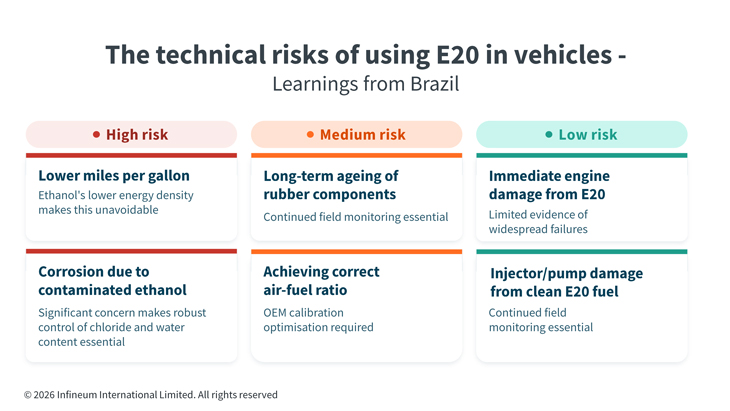
Looking closer at the risks, while the mileage penalty is unavoidable, vehicle durability concerns should focus on fuel quality management, rather than simply on the ethanol blend ratio. This means more robust control of chloride contamination, water content, storage conditions and distribution infrastructure is likely to be far more important than debating E10 versus E20 and beyond. Continued field monitoring by OEMs and agencies such as the Automotive Research Association of India (ARAI) will be essential, to enable India to accumulate long-term durability evidence to allay consumer concerns.
The decades of experience in Brazil of using E20 and higher blends of ethanol in petrol do not support the idea that E20 fuel inherently causes widespread vehicle damage.
The stronger risk signal comes from fuel contamination and quality control, particularly chloride contamination, rather than the ethanol blend level itself.
In the short term, the focus is expected to be on stabilising the quality of E20 fuels across the country, developing a wider and more available portfolio of E20-compatible vehicles and addressing consumer concerns. Both the government and OEMs are actively promoting flex-fuel technology and, following Brazil’s lead, we can expect the number of vehicles using E20 to E100 to increase.
An emerging trend is the shift away from sugar-based feed-stocks towards grain-based and second generation (2G) sources to help improve the sustainability perspective of ethanol fuels.
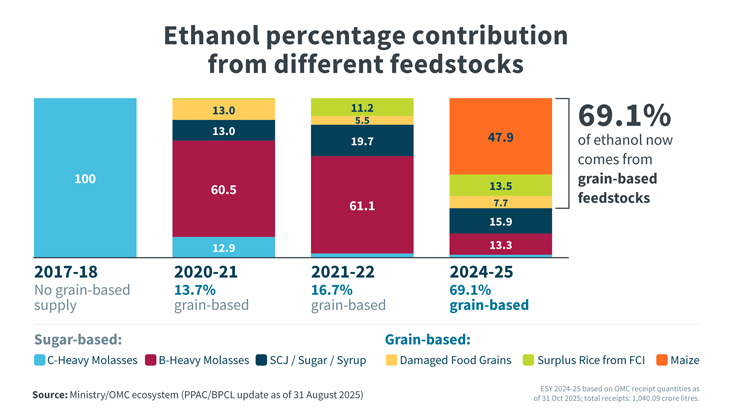
The latest available data show that the feedstock mix has shifted significantly from molasses to grain-dominated ethanol production. Maize has emerged as the dominant ethanol feedstock, now accounting for approximately 48% of total ethanol receipts. And the combined contribution from grain-based feedstocks (maize, surplus rice, and damaged food grains) has reached approximately 69%.
Maize is expected to remain an important feedstock, but there is also likely to be an expansion of 2G feedstocks including:
Moving to these feedstocks is not only more sustainable, but also helps to dispose of waste biomass, address concerns about stubble burning and removes food-versus-fuel concerns.
Looking further ahead, over the next decade, there is a possible pathway toward higher ethanol blends of E25, E30, E85 and even E100 for flex-fuel vehicles.
However, right now E20 stabilisation remains the most pressing priority – requiring action from government, OEMs and across the whole supply chain. And, while industry discussion around higher blends may be progressing, widespread deployment of blends above E20 will require significant advances to vehicle and infrastructure readiness.
The transition to lower carbon fuels brings challenges and opportunities across the automotive, lubricants, fuels and transportation additive sectors. Infineum is working closely with industry stakeholders to help ensure the success of the industry transition and is committed to enabling the adoption of greener technologies. If you have any questions or need further details, please contact us.
Sign up here to receive email alerts so that you never miss out on new content from Infineum - and make sure you follow Infineum Additives on LinkedIn.
Sign up to receive monthly updates via email