Lubricant trends
Creating value in an era of uncertainty
29 September 2026
07 July 2026
How digital tools and AI are supporting current and future additive technology developments

Major forces including tightening emissions regulations, sustainability ambitions and shifting end-user expectations are shaping the future of transportation. As OEMs explore a wide mix of powertrain technologies, hardware systems and energy sources, the vehicle landscape is becoming ever more complex. Insight reports on a presentation delivered by Infineum Global Technology Director, Sinead Adamski, at the UKLA Future of the Lubricants Industry Conference, which explores how digitalisation is supporting the development of robust, high-performing lubricants as formulators work to manage an increasing number of variables, rising demands for validation and shorter development timelines.
The forces shaping the automotive market including tightening emissions regulations, sustainability ambitions and efficiency expectations are well understood. Rather than exploring these drivers for change, Sinead opened her presentation with a question - what does all this mean for the lubricant development process itself?
One challenge Sinead sees arising from these drivers that formulators are navigating is market fragmentation, which she suggests creates a broader portfolio of vehicles all with very different lubrication requirements.
First this fragmentation comes in the form of powertrain selection. In recent years, the share of full battery and hybrid electric vehicles has grown, predominantly in cars and buses. But, at the same time, petrol and diesel powered internal combustion engines still represent a significant share of the market across all transport applications.
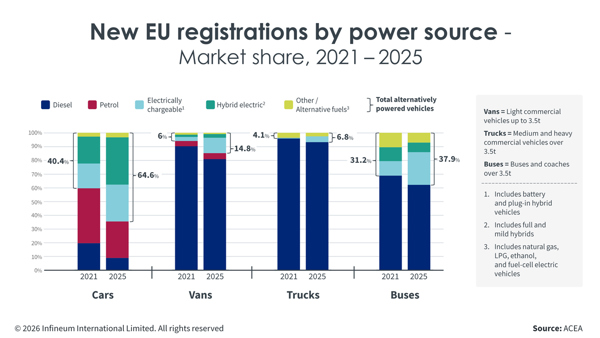
For lubricant developers, this creates a broader operating environment, with the need to support new electrified platforms, highly efficient internal combustion engines, hybrid duty cycles and legacy applications at the same time.
In addition to powertrain diversification, a second pressure point Sinead identifies, as vehicles remain in service for longer, is an aging fleet. In the EU, from 2019 to 2025, the average age of passenger cars and trucks has increased from 11.5 to 12.5 years and from 13.0 to 14.1 years respectively.
In terms of lubricant formulations, she says this means developers need to work across a very wide performance envelope. New engines demand lower viscosity lubricants for improved fuel economy, while also ensuring aftertreatment compatibility and protection for more advanced materials. Older vehicles still require robust durability and cleanliness over long service intervals.
All this means a wider formulation challenge and results in a more complex product portfolio.
The second challenge highlighted by Sinead is that, although the energy transition is coming, for now the pace of emissions legislation and the resulting changes to lubricant specifications are driving even tighter requirements at a much faster pace.
In Europe, the headline is Euro 7. It is the first emissions standard to look beyond the tailpipe, now including the particulates that come from brakes and tyres. For cars and vans, it applies to new type approvals from November 2026, and to all new vehicles from November 2027. For trucks and buses, it applies to new type approvals from May 2028, and all new vehicles from May 2029. And, in the US, the EPA 2027 heavy-duty standards bring much stricter NOx limits, sharpening the focus on durability and aftertreatment performance, although the warranty and useful-life provisions may still be revised.
Supporting these tightening emissions regulations, the specification picture is just as busy. In North America, for passenger cars, ILSAC GF-7 and API SQ began licensing in 2025 and PC-12, which introduces the new API CL-4 and FB-4 categories for heavy-duty formulations, is scheduled for first licensing in January 2027. In Europe, the ACEA 2024 light-duty and heavy-duty oil sequences became mandatory for new claims from September 2024 and December 2025 respectively.
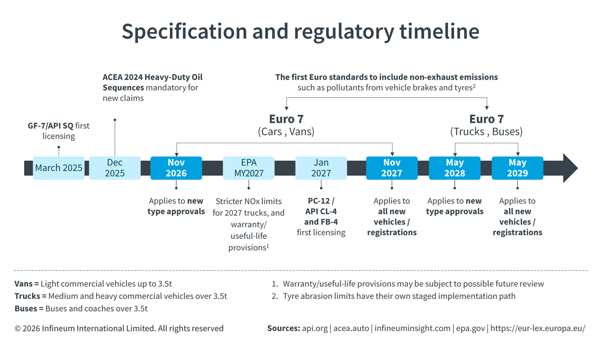
In Sinead’s view, all of this matters because it directly affects development planning. Formulations need to be ready for new categories, new tests, new limits and new claims expectations, and the time available to achieve all this is getting shorter. The target keeps moving and confidence has to be built before market introduction, not afterwards.
We are now operating in a market with ever rising complexity in additive development.
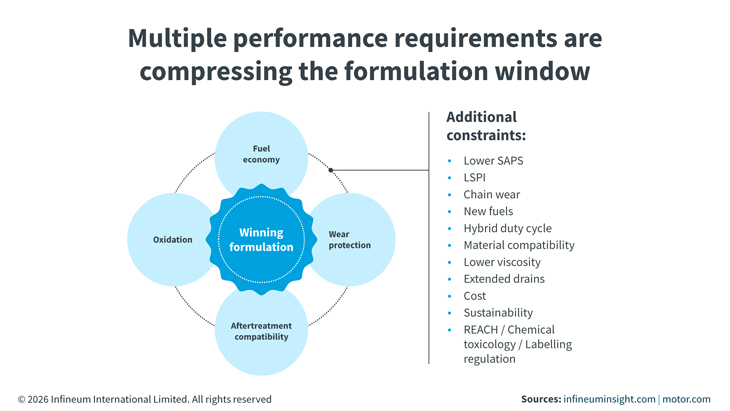
While Sinead confirms that moving to lower viscosity lubricants supports efficiency gains, she says it also increases the demand for exceptional wear protection. Lower sulphated ash phosphorus and sulphur (SAPS) chemistry is designed to support aftertreatment compatibility, but it also constrains the chemistry available to the formulator. In addition, longer useful life expectations increase durability requirements. Hybrid operation presents new challenges for fluids, which must ensure performance is maintained under intermittent engine operation, increased exposure to water and fuel and fluctuating thermal and environmental conditions. Last but not least, new fuels, including biofuels, hydrogen and ethanol, and widely differing regional requirements introduce even more variability.
According to Sinead, this means the development task is no longer about optimising one performance area in isolation. It is about finding a formulation window where multiple requirements can be met together, without creating unacceptable trade-offs elsewhere.
What Sinead says she sees emerging is a development bottleneck – with the real constraint being validation bandwidth.
Every promising formulation must move through a robust evidence pathway. Bench tests, rig tests, engine tests, teardown, rating, interpretation and documentation all take time. While all this testing is essential to give customers confidence in product performance, it is also costly and time consuming and, as the number of formulation variables grows, the traditional learning cycle becomes harder to scale.
We can generate formulation options, but proving performance takes time, capacity and confidence.
But now, Sinead continues, digital and AI tools are allowing us to extract more learnings - before, during and after testing, but they are not replacing the validation process. Today, digital tools are already improving the development cycle. Historical data, formulation knowledge and test results can be modelled more effectively, with AI helping teams explore a wider candidate space and prioritise the most valuable tests. Instead of treating every test as an isolated event, it is possible to connect the evidence across programmes, chemistries, hardware types and performance requirements.
That means the role of testing becomes more targeted. We are not simply asking if the formulation is a pass or fail. We are also asking: what does this result teach us, how does it compare with previous evidence, what pattern does it reveal, and how should it influence the next formulation decision?
A second improvement Sinead sees is data capture. If test outputs, images, metadata, ratings and expert conclusions are captured in a structured and reusable way, the learnings do not remain locked in individual reports or isolated project files – they become part of a stronger evidence base that can inform future programmes.
Looking ahead, she says generative AI and agent-enhanced workflows could further compress the cycle. For example, they may help teams search and summarise evidence, prepare test documentation, process results, flag anomalies, or connect findings across multiple data sources. More agentic workflows may automate some of the repetitive data handling and workflow steps around testing.
The key message is digitalisation and AI are tools that enable human enhancement not human replacement.
Sinead is keen to stress that the technical judgement still sits with the experts. AI can help detect patterns, accelerate analysis and improve workflow efficiency, but trusted outcomes still depend on high quality data, validated methods, controlled testing and expert interpretation. And we can help to make it more intelligent - better prioritised before testing, better structured during testing, and more reusable after testing. Ultimately, the real value lies in the quality and reuse of the learnings taken from testing programmes and the ability to compress the development cycle.
Sinead believes the opportunity is clear. By combining digital capabilities with strong technical discipline, we can move faster while maintaining the confidence and evidence base this industry depends on.
Sign up to receive monthly updates via email