Lubricant trends
Creating value in an era of uncertainty
29 September 2026
26 May 2026
Latin America transitions to cleaner and more sustainable transportation powered by renewable energy sources

Estimates from United Nations Development Programme suggest transportation in Latin America accounts for more than 37% of its total CO2 emissions, and the Organisation for Economic Co-operation and Development reports air pollution levels in many cities remain above World Health Organization guidelines – issues regulators are keen to address. Carolina Silva, Infineum Industry Liaison Advisor for Latin America, looks at local vehicle market trends and explores the advances being made in the use of greener energy sources, as the region works to reduce greenhouse gas emissions and its dependency on fossil fuels, while also improving the quality of urban life.
To set the scene, let’s start with an overview of the light- and heavy-duty vehicle markets. In recent years, the region’s light-duty vehicle production has been growing and, while this trend is forecast to continue in Brazil, there is expected to be a levelling off in other key markets.
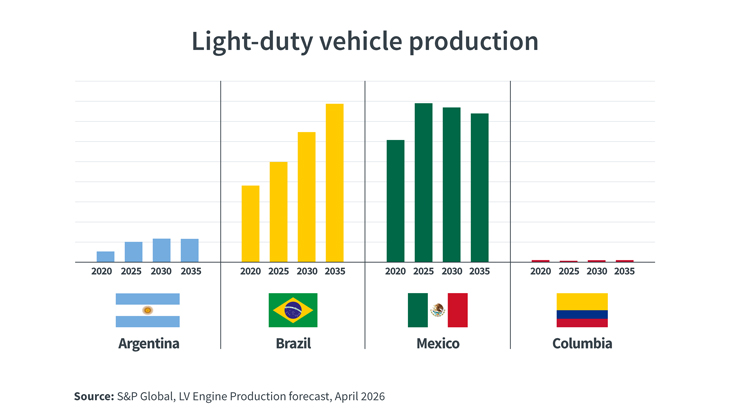
This feature will concentrate on the two largest Latin American vehicle markets, Brazil and Mexico.
According to data from the Brazilian Association of Automotive Vehicle Manufacturers (ANFAVEA), while Brazil saw a growth in sales of light-duty cars and light-duty commercial vehicles of 2.6% in 2025 vs 2024, the figures are lower than had been expected. However, from July to year end, sales were enhanced by the Sustainable Car Program, which was introduced as part of the Green Mobility and Innovation Program (MOVER). In addition, data from the Brazilian Electric Vehicle Association (ABVE) show a new record for sales of ‘electrified’ vehicles was reached, with an astounding 60.8% growth in 2025 vs 2024.
The picture is different for heavy-duty commercial vehicles, where lower demand saw production in Brazil fall by more than 12% in 2025 vs 2024. The slowdown in sales is mainly attributed to high interest rates and constrained credit availability, which means less financing is available for fleet renovation.
In Mexico, light-duty sales are thought to have hit a record high of 1.62 million vehicles. However, since it is not compulsory for OEMs to submit sales data, this figure can only be viewed as an estimate. Strong competition from a large group of Chinese automakers has kept the sector buoyant despite weak economic growth and uncertainty surrounding the impact of US tariff policies.
Looking at heavy-duty vehicles in Mexico, following a record 2024, when some 58,000 units were sold, domestic sales contracted 46.3% in 2025. The main reasons are thought to be uncertainties regarding changes in North American trade policy and postponed fleet-renewal decisions amid weaker investment expectations.
The key drivers for change in the vehicle markets of Latin America centre on new regulations aimed at improving air quality, reducing greenhouse gas (GHG) emissions and creating a more sustainable future. All these initiatives could drive up the adoption of electrified vehicles, the use of alternative fuels and more localised production.
In Brazil, PROCONVE emissions regulations have been progressively tightened to improve air quality. The latest, PROCONVE L8, introduced for light-duty vehicles in January 2025, aligns closely with Euro 6, with tighter limits for non-methane hydrocarbons (NMHC).
In Mexico, NOM-042 is being tightened to Environmental Protection Agency (EPA) Tier 3 levels from 2026.
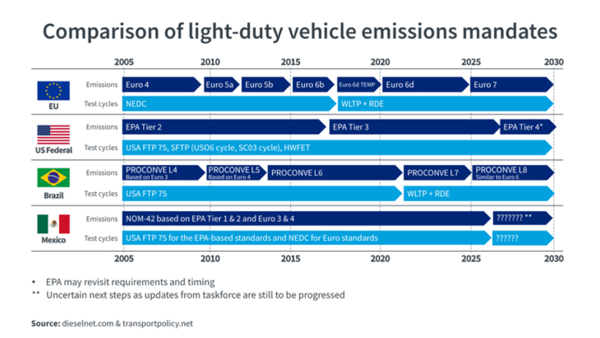
For heavy-duty vehicles, in Brazil, PROCONVE P8, which is aligned with Euro VId, has applied to all vehicles registered and sold since January 2023.
These emissions regulations have prompted significant hardware changes including the use of gasoline and diesel particulate filters, advanced exhaust aftertreatment systems, and more complex engine management and onboard diagnostic systems.
In support of its net zero GHG emissions by 2050 goal, Brazil has updated its Nationally Determined Contribution (NDC) to the Paris Agreement. The NDC establishes an economy-wide target of reducing net GHG emissions by between 59-67% below 2005 levels in 2035.
Submitted in November 2025, Mexico's NDC 3.0 sets a 2035 target, featuring an absolute, unconditional emission cap of 364–404 MtCO2e, which is a 19–31% reduction from 2023 levels along with a conditional target of 332–363 MtCO2e. The new framework focuses on energy transition, electric mobility, industrial efficiency, and social justice.
According to Brazil’s System for Estimating Greenhouse Gas Emissions and Removals (SEEG), which is an independent platform for monitoring greenhouse gas emissions, transportation accounted for around 10% of its CO2 emissions in 2024, while in Mexico estimates suggest it accounts for some 20%.
However, the International Energy Agency (IEA) reports that when looking at total CO2 emissions from energy sources the figures change, making this sector a key target for government initiatives.
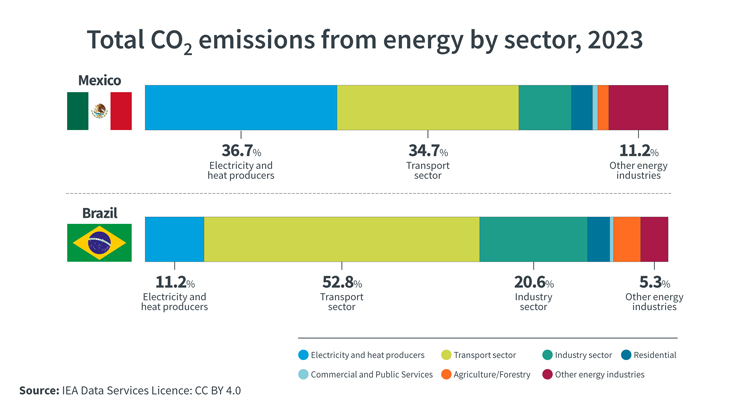
Source IEA 2026; www.iea.org/countries/brazil/emissions and www.iea.org/countries/mexico/emissions, License: CC BY 4.0
In Brazil for example, the MOVER Program, introduced in 2024, is designed to promote sustainable mobility, support a circular economy, and reduce the carbon footprint of products. The Program will introduce incentives to encourage innovation in greener technologies and create tax benefits for flex-hybrids and full ethanol hybrids. Phase 1 targets a well-to-wheel energy consumption reduction for light-duty vehicles of 12% by 2027, while Phase 2 mandates a 50% cradle-to-grave CO2 reduction by 2030.
In Mexico, Phase 2 of the NOM 163 standard that regulates CO2 emissions from light-duty vehicles was published in January 2024. The annual targets are set to achieve 89 g CO2/km for passenger cars and 131 g CO2/km for light commercial vehicles by 2027.
The cost of electricity and matrix of supply in Latin America is very different from other regions of the world. Here clean energy can be generated from solar, hydro and wind power rather than from fossil fuels. According to the IEA, in Brazil renewables meet almost 45% of primary energy demand, making its energy sector one of the least carbon-intensive in the world.
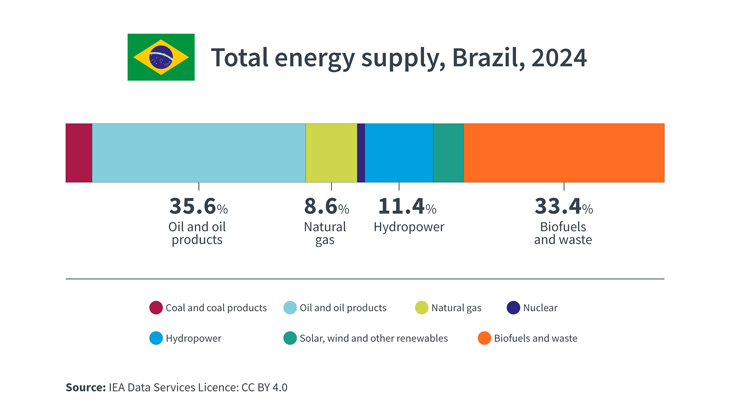 Source IEA 2026; www.iea.org/countries/brazil/energy-mix, License: CC BY 4.0
While electricity generation from these non-fossil derived sources looks set to grow in the coming years, lack of recharging infrastructure is currently a key barrier to the wider adoption of full battery electric vehicles (BEV).
Although Brazil’s vehicle charging network has expanded to nearly 17,000 public and semi-public chargers as of mid-2025, infrastructure growth lags behind vehicle adoption. Government initiatives, including the National Electric Mobility Plan, are driving investment in charging networks, grid modernisation, and smart grid solutions, including battery storage and load management. However, this is a challenging issue to overcome and requires significant investment to achieve.
In Mexico, recent reports suggest there are just over 2,000 electric vehicle charging stations and 4,800 chargers distributed across the country, most operating at the slow or semi-fast charging levels.
As sales of BEV and hybrid vehicles accelerate in the region, the big question for the sector is whether the public charging network will be able to keep pace with an increasingly electrified vehicle parc.
The good news is that since the region has adopted a technology agnostic approach to decarbonisation, alternative fuels are also expected to play a key role into the future.
The MOVER Program and the ‘Future Fuels Legislation’ are supporting the energy industry as it works to promote Brazil as a hub for biofuels.
Record biofuel production in 2023/2024, has elevated Brazil the position of second largest producer in the world.
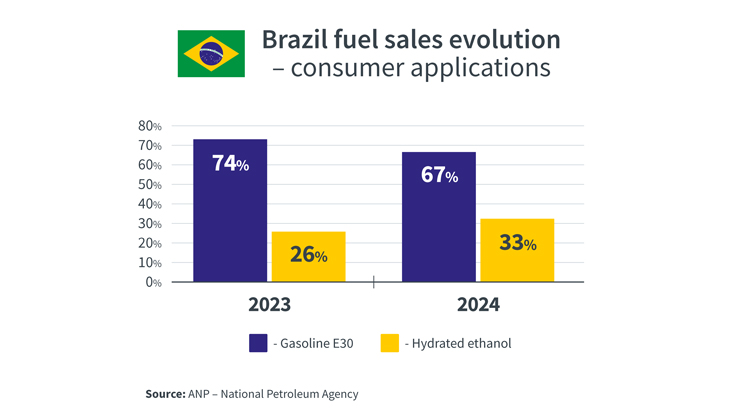
The favourable price of ethanol vs gasoline and its ready availability make it an increasingly popular choice for motorists.
For commercial vehicles, currently the use of B15 (15% of 100% biofuel blended into diesel fuel) is growing.
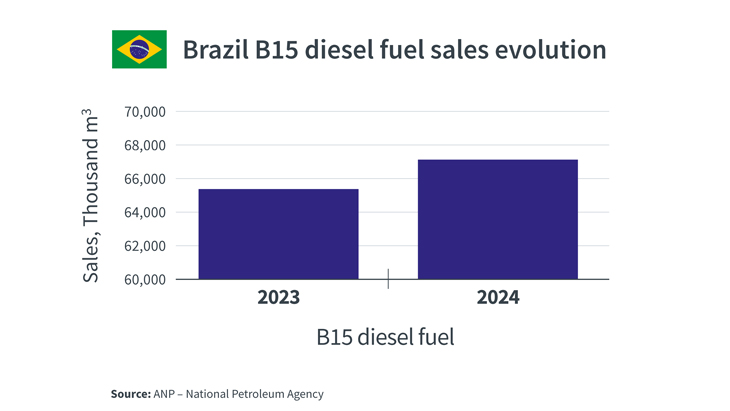
Looking ahead, Brazil’s biofuel regulation driven by the ‘Fuels of the Future’ law, mandates the percentage of B100 to be blended into diesel fuels increases by 1% annually to reach 20% (B20) by 2030. Ethanol blending into gasoline was set to 30% in August 2025, with a target of reaching 35% by 2030. If these targets are met, the demand for biofuels is expected to grow significantly.
The tightening CO2 emissions regulations, combined with government incentives and tax breaks are designed to encourage consumers to adopt electrified passenger cars, including hybrids capable of running on ethanol. In the heavy-duty sector, where powertrain electrification is more challenging, it is likely that the use of alternative fuels, including biofuels, will continue to increase.
Changes in fuel type and hardware design will have significant impacts on future engine lubrication requirements and may present opportunities for specialised fluids.
This is the first in a series of articles on the fast changing markets in Latin America. Our next instalment will take a closer look at the light-duty vehicle segment and the associated lubricant challenges and opportunities that are arising.
Sign up here to receive email alerts so that you never miss out on new content from Infineum - and make sure you follow Infineum Additives on LinkedIn.
Sign up to receive monthly updates via email