Base stocks
Base stock instability
29 September 2026
21 April 2026
Re-refined base oils move onto the centre stage

Environmental aspirations mean there has been a growing level of interest in the potential benefits of using re-refined base oils (RRBO) in finished lubricant formulations. At this year’s ICIS World Base Oils Conference, RRBO moved from side bar discussions to being firmly in the spotlight on the main stage. Insight reports on the key presentations, which covered the role of RRBO in the circular economy, the benefits they can deliver and what is needed to help ensure their wider adoption in the future.
The 30th ICIS World Base Oils Conference delivered deep insights into both the challenges the re-refining industry is facing and the opportunities that are arising. The speakers from Slicker Recycling and AVISTA OIL AG delivered inciteful presentations from slightly different perspectives. One of the key common themes was that while reducing greenhouse gas emissions (GHG) remains a strong driver for using RRBO, there is a growing push from policy makers who see them as a valuable way to help conserve precious natural resources.
First up on stage was Mark Olpin, Executive Chairman from Slicker Recycling, market-leading specialist in the collection and recycling of waste oils and other waste management and environmental services. His presentation, titled Closing the loop: Collection and diversion mechanisms for re-refined base oils, explored some of the advantages and challenges of re-refining used oils.
Mark started his session with a look at why, in his view, re-refining used oil is the smart choice. He showed how re-refining used lubricant oil (ULO) into base oils not only reduces GHG emissions, conserves our finite natural resources and contributes to a circular economy but also provides additional high quality feedstock into the base oil market.
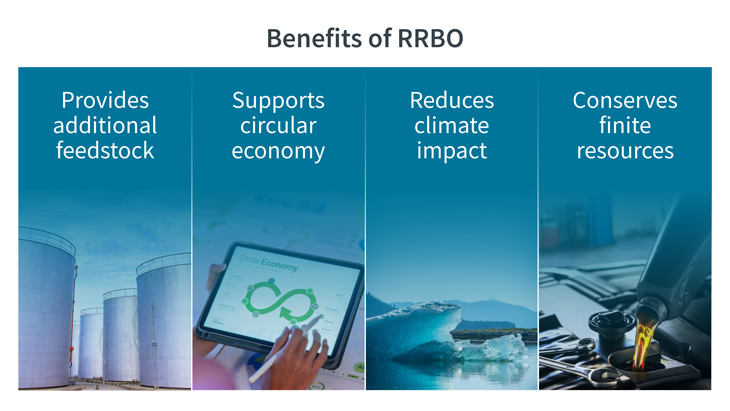
With crystal clear environmental benefits, it’s hard to see why currently the used oil that is being collected is not all being re-refined.
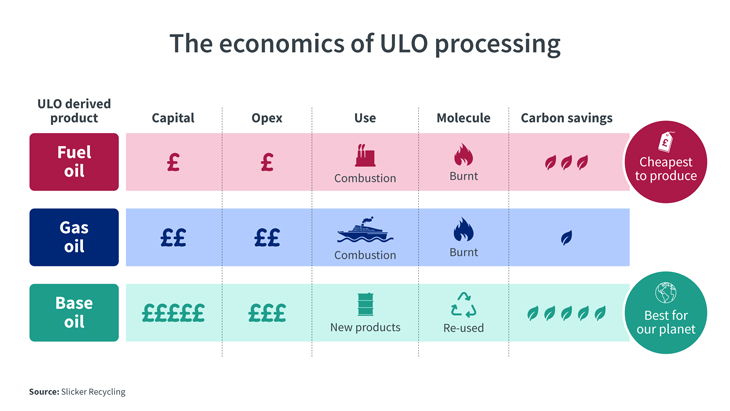
But, when you dig deeper, because ULO can also be used to produce fuel oil and gas oil, economic factors also come into play. Whilst fuel oil is typically the cheapest to make, the economics of production have been unfavourable recently. However, when gas oil prices are high, relative to base oil, gas oil production becomes the most financially profitable solution for ULO.
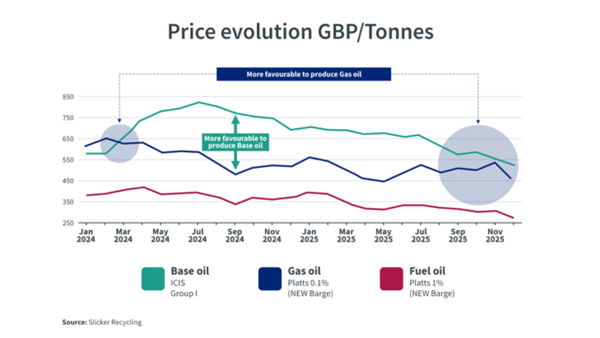
Re-refiners face stiff competition for ULO feedstock from the combustion and energy-recovery sectors.
Mark Olpin, Slicker Recycling
The challenge with the gas oil production approach is that gas oil is ultimately burnt, whereas re-refined base oils can be converted into lubricants, collected and re-refined again and again – making them the best option for our planet.
So how do we address this carbon dichotomy? Mark shows three clear routes: legislation, economics and societal pressure. Looking at legislation, he sees three main options - a total ban on burning waste oil, second a target of ULO volume that must be re-refined and third mandating a certain percentage of RRBO that ends up in finished products. In Europe, the Waste Directive requires all waste handlers to follow the waste hierarchy. However, despite the fact that re-refined materials have a high ranking, enforcement of this legislation is currently minimal – something he feels needs to be addressed.
In terms of economics Mark highlights both carrot and stick options. On the incentive side subsidising ULO producers and collectors, RRBO producers and lubricant manufacturers along with funding, such as Extended Producer Responsibility schemes, virgin material levies and carbon credits are all positive financial options. On the ‘stick’ side taxing each litre of ULO sent for combustion could also help.
While legislative and economic mechanisms exist to encourage the re-refining of ULO, they are not universally applied nor enforced, meaning significant volumes are still burned.
Mark Olpin, Slicker Recycling
Last but not least is societal, which Mark sees as an area we can all influence. Actions can include raising the awareness of the benefits of re-refined products within the lubricants industry and lobbying regulators to influence policy decisions.
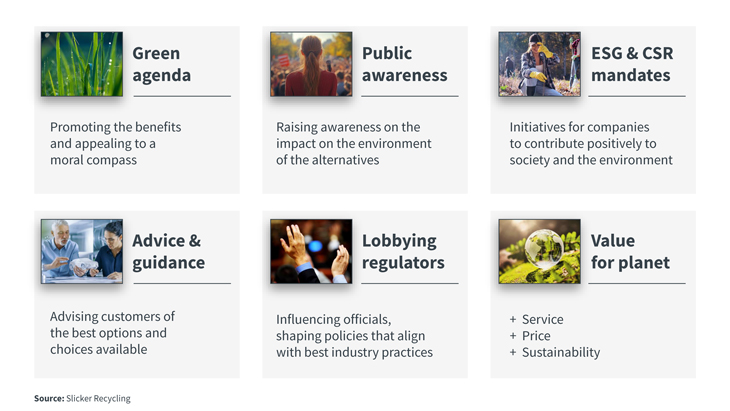
Mark closed his talk with this thought: it is hard to overcome the economics, which currently mean gas oil production is the most profitable route for ULO. But, if we consider our responsibilities to society and the environment, then base oil wins on sustainability, circularity and value for our planet – which in the face of economics, needs strong legislation and regulators to enforce.
Also on centre stage was Mario Majic, Head of Business Development at AVISTA OIL AG, a global leader in waste oil management, re-refining, and recycling. His presentation, titled Circularity pathways, explored the sustainability and performance benefits of using RRBO.
Mario started his talk with the idea that while circularity is not simple it is increasingly important.
Circularity pathways increase independence and resilience of critical raw materials supply, exploit the raw materials already contained in products sold and deliver environmental benefits.
Mario Majic, AVISTA OIL AG
A number of European Commission regulations, for example, the Critical Raw Materials Act and the Circular Economy Act, already contain circularity requirements for raw materials. But, how does circularity translate to the lubricants industry?
Mario explains that one of the biggest differences with RRBO production is that it is a more local business vs virgin base oil (VBO) production, which is global. When you consider the entire product lifecycle this makes a significant difference in where the environmental burden resides. He went on to illustrate the product carbon footprint (PCF) reductions RRBO can offer using the production of a SAE 10W-30 Super Tractor Oil Universal (STOU) as an example. Using VBO the PCF is 2.5 kg CO2eq (c2og)* vs producing the same product from RRBO where the PCF is only 0.8 kg CO2eq (c2og)*. In addition to cutting carbon emissions, switching this formulation to RRBO would have other significant environmental benefits.
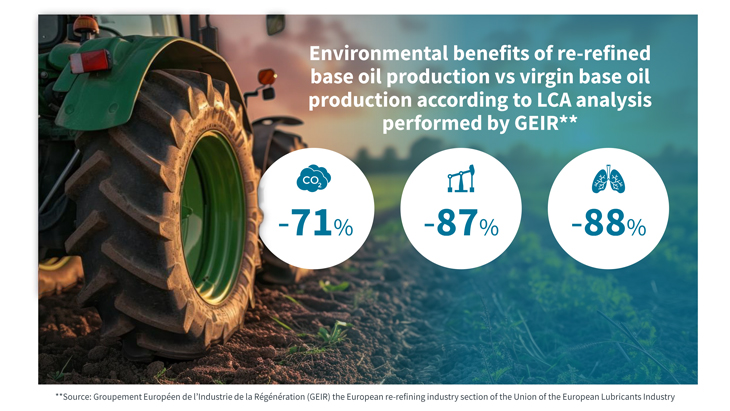
However, one of the key challenges lubricant formulators raise regarding the use of RRBO is their performance vs VBO. Here Mario was very clear saying it is vital to compare like with like because not all RRBO are the same, but neither are all VBO. Using the API criteria of base oil separation: sulphur content, viscosity index (VI) and saturates, it is possible to compare them.
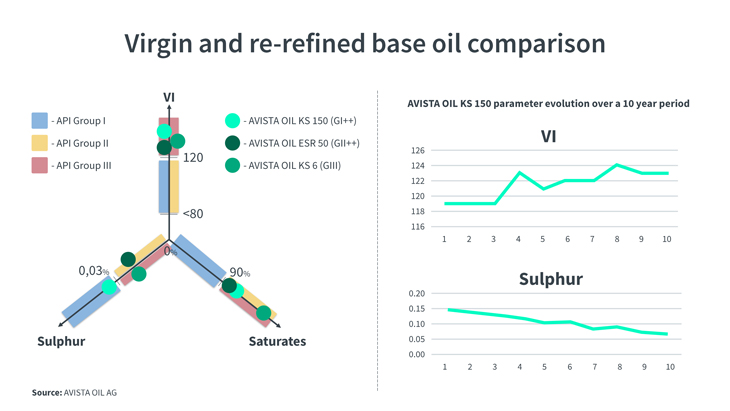
Over time, AVISTA OIL AG reports that RRBO sulphur levels have come down as ULO feedstock has improved and VI is high. In addition, the higher proportion of saturates results in improved oxidation stability, which translates into better retained properties for the lubricant and longer drain intervals.
The final theme of Mario’s talk was one of the need for collaboration and enforcement of regulations. Currently only 1.6 million tons of used oil is collected with 39% still being used in products that are ultimately burnt. In Mario’s view all participating stakeholders in the value chain, including OEMs, need to be involved at the start to design in systems that allow used oil to be collected. This needs to be backed by legislation, which must then be enforced – something that right now is not entirely harmonised or followed equally within the EU.
Circularity in the lubricants industry is complex, and we need closer cross-industry ties to increase the volume of ULO collected and the proportion that is re-refined into base oil.
Mario Majic, AVISTA OIL AG
Infineum has been working to incorporate more RRBO into formulations and to make circularity and PCF improvements available to our customers.
Having already completed more than 24 million miles of field testing with RRBO, we are ready to unlock the potential of RRBO and to identify new sources of value so that we can support the needs of all stakeholders in the lubricant ecosystem.
Find out more about what Infineum has been doing here.
* PCF calculated using ATIEL/UEIL PCF methodology comparing same product with different base oil sources (AVISTA OIL Kernsolvat based vs. Virgin based (ifeu data))
Sign up to receive monthly updates via email