Passenger cars
A diversifying market
25 August 2026
21 April 2026
Extensive on-road testing confirms the need for hybrid-specific lubricants

Across the world, the popularity of hybrid electric vehicles is continuing to grow as consumers look for affordable, fuel-efficient and environmentally sustainable personal mobility solutions that also offer extended driving range and operational flexibility. Ruifeng Zhang, Infineum Asia Pacific Team Leader Deep Expertise Engineering, explores the new challenges the latest plug-in and range extended hybrid electric vehicle architectures present for engine lubricants, and reveals the results of extensive field testing carried out under diverse real-world operating conditions.
Recent data show continued growth in the global production of hybrid electric vehicles, including full hybrids (HEV), mild hybrids (MHEV), plug-in hybrids (PHEV) and range extended electric vehicles (REEV), to meet rising consumer demand. From almost 24 million in 2025, production of hybrid vehicles is forecast to reach more than 38.5 million by 2030, which would represent some 40% of all cars produced. This forecast also suggests that out to 2038 more than 50% of vehicles sold will still contain an internal combustion engine (ICE).
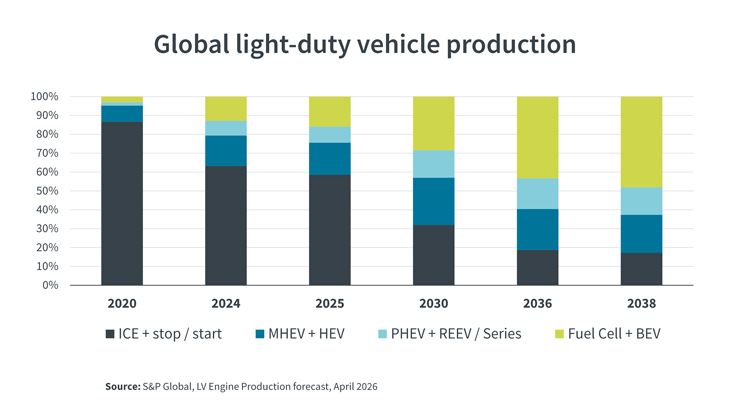
However, regional trends in consumer choice of powertrain vary widely. Our Future of Mobility hub has been tracking the pace of electrification in a number of markets.
In China, for example, the automotive market continues to grow and by May 2025, passenger vehicle sales reached 11 million, an increase of 13% year on year (YoY) - mainly driven by a booming new energy vehicle market. However, in this timeframe, sales of battery electric vehicles (BEV) maintained a faster growth rate than PHEV/REEV (48% and 35% YoY respectively).
In the US, in the first half of 2025, automotive sales remained strong, with some indication that many consumers decided to purchase early to avoid proposed tariffs. While electric vehicle sales declined year over year, the ‘electrified’ (BEV, PHEV, and HEV) models’ share of new vehicle sales continued to grow, with a heavy influence from HEV in 1Q 2025.
Data from ACEA show that across Europe, hybrid vehicles accounted for 44% of 2025 passenger cars sales up from 39% in 2024. While BEV sales grew to reach 19.5% of 2025 sales, ICEs, including non-plug-in hybrid electric vehicles, still powered over 70% of new vehicles sold.
In India, consumers have been relatively slow to embrace electrified cars, with hybrids accounting for 11% of passenger car sales in 2024.
To meet this rising demand for ‘electrified’ vehicles, OEMs are introducing a variety of hybrid powertrains.
Two powertrains that are gaining popularity are PHEV, which combine electric propulsion with an ICE to provide flexibility in energy source and extended driving range, and REEV, which further optimise electric driving by using the ICE primarily as a generator. These architectures are being introduced to help cut emissions today while the barriers to net zero emission options are removed and BEV vehicles are further developed and commercialised.
The evolution of these hybrid powertrain systems introduces distinct operating characteristics such as frequent engine start-stop events and reduced average engine loads that are very different to conventional ICE vehicle usage profiles. In addition, pressure from OEMs and end users for extended oil drain intervals, up to 30,000 km or two years, increases the performance demands on the lubricant. All these changes present new challenges for fluid formulators who must ensure performance is maintained under intermittent engine operation, increased exposure to water and fuel and fluctuating thermal and environmental conditions.
It is well documented that conventional lubricant formulations, designed for continuous operation in ICEs, may not sufficiently address the demands of hybrid applications.
Infineum has already studied the impact of hybrid engine architectures to explore the challenges of oil emulsification and water entrainment. Read more about the findings here.
This article focuses on relatively under explored, yet industry relevant, aspects of hybrid engine lubrication including piston cleanliness, long-term aging, oil degradation and lubricant compatibility with gasoline particulate filters (GPF).
To assess the impact of diverse operating conditions on engine oil performance and to support the development of lubricants specifically formulated for PHEV and REEV, three vehicle field trials have been conducted over the past five years. A total of 36 new test vehicles were deployed: 20 based in Shanghai, China, representing a congested urban driving cycle the others in Heihe, Heilongjiang Province, a town in northern China, characterised by extreme cold conditions, with average winter temperatures of around -25OC. Over the combined fleet trials, the performance of 20 different lubricant formulations has been evaluated.
A novel diagnostic metric, known as piston specific coking time (expressed in s/km) was introduced to assess the impact of engine operating conditions on piston deposit formation. After accounting for variations in driving cycle characteristics, our testing, in PHEV with SAE 0W-20 formulations in these trials, reveals that premium lubricant formulations featuring salicylate detergents and higher treat rates provide the strongest positive influence on piston cleanliness versus mid-tier and baseline products.
These results highlight the effectiveness of advanced additive technologies in mitigating piston deposits under typical PHEV operating conditions.
OEMs and end users are raising concerns regarding lubricant durability during extended periods of vehicle inactivity. To addresses them, simulated aging tests with used oils (15,000 km and 30,000 km) were carried out over a two year period. The results on testing show stable values in key lubricant parameters including kinematic viscosity (KV), total base number (TBN), total acid number (TAN), and oxidation.
Oil degradation has also been assessed for REEVs equipped with ICE and an exhaust gas recirculation (EGR) system. Results indicate that, particularly those of the non-plug-in type REEV, high performance engine oils with enhanced resistance to nitration are essential to ensure adequate protection and long term durability.
Lastly the lubricants’ compatibility with gasoline particulate filters (GPF) was assessed. Here the reduced ICE engagement in modern PHEV and REEV results in lower ash accumulation, thereby enabling the potential use of higher ash engine oils in GPF-equipped hybrid vehicles, allowing longer oil drain intervals without compromising filter durability performance.
Our extensive field trials carried out under extreme conditions have enabled us to further our understanding of the challenges associated with different hybrid powertrains and driving cycles.
As the popularity of PHEV and REEV architectures continues to grow, they have the potential to retain a large share of the global vehicle population for many years to come.
Lubricant suppliers have an exciting opportunity to provide differentiated products specifically designed to deliver the protection hybrids need.
We are ready to help with field-proven hybrid fluids that cover a broad spectrum of OEM requirements, now and into the future.
Sign up to receive monthly updates via email