Fuels
Treating sludge onboard
17 February 2026
24 March 2026
Designing lubricants to deliver protection to hydrogen internal combustion engines

As the efforts to reach net zero emissions intensify, the appeal of using alternative low and zero carbon fuels in internal combustion engines (ICEs) is growing. Hydrogen is an attractive option for larger applications, although it comes with a new set of challenges, with pre-ignition being the primary concern for OEMs. Carina Foster, Infineum Commercial Vehicles New Specifications Technologist, talks to Insight about recent lubricant development work that is helping to minimise the number of pre-ignition events in ICEs running on hydrogen.
To meet their greenhouse gas emissions reduction commitments, OEMs in the transportation industry are looking to transition away from burning fossil-based fuels towards low and zero carbon energy sources. In the commercial vehicle segment, where powertrain electrification is challenging, there is a growing interest in using hydrogen in conventional internal combustion engines (H2ICE). This set up can provide the power, efficiency and the load carrying capacity these applications need, and its advantages mean it is already moving into the testing and commercialisation phase. While lack of refuelling infrastructure and availability of green hydrogen have been the biggest barriers to its adoption, significant investment is being made in these areas.
In the past five years the Hydrogen Council reports steady growth of operational clean hydrogen, with most volumes being produced in North American and China.
The US is currently focused on producing low carbon hydrogen, often referred to as 'blue hydrogen', driven by the Inflation Reduction Act (IRA) and associated tax credits. In Europe, a large number of projects are dedicated to renewable ‘green’ hydrogen' capacity growth, driven by regulation and policy. The Asia-Pacific region, led by China and increasingly India, is emerging as the fastest growing in terms of operational green hydrogen facilities.
The rapid growth of green hydrogen production in China stems from several factors. These include high capacity for electrolyser manufacturing (approximately 60% of total production) and the economies of scale, as well as low-cost renewable energy. Importantly, this is underpinned by strong government policy aimed at achieving carbon neutrality and decarbonisation of industrial processes. As a result, the price of green hydrogen in China is approximately three times lower than elsewhere, and the country is expected to produce more green hydrogen than the rest of the world combined in 2026.
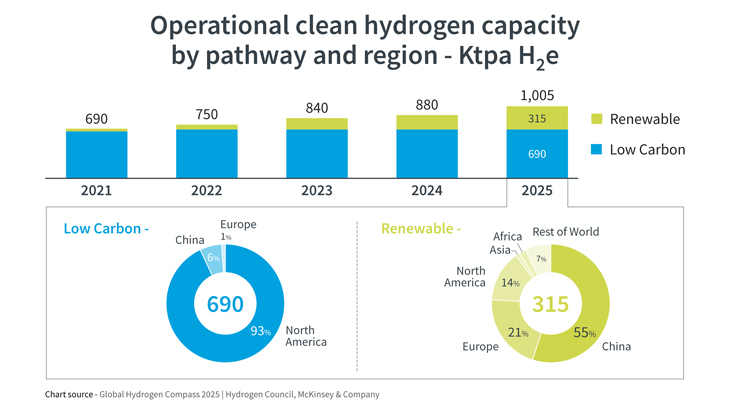
According to the Hydrogen Council, 9–14 mtpa of clean hydrogen capacity could feasibly come online by 2030, which is split evenly across renewable and low carbon capacity. However, the ultimate volumes will depend on how much of that capacity can secure stable, likely policy–backed, offtake. Without secure demand, the Council says supply projects will remain stranded.
In the past five years, there has also been a steady increase in the number of hydrogen refuelling stations (HRS).
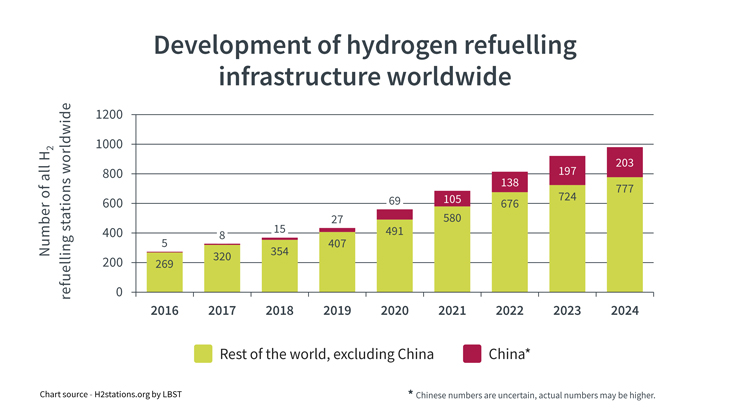
Looking out to 2030, although there is a high level of uncertainty, analysts suggest there could be more than 6,000 HRS across the world. These continued investments in supply and infrastructure mean that the use of hydrogen in the commercial vehicle sector is increasingly viable.
One of the key advantages of developing internal combustion engines that enable commercial vehicles to run on hydrogen is hardware familiarity – making current operational experience and servicing skills relevant well into the future. However, although the lubrication requirements of internal combustion engines running on diesel fuels are well understood, the use of hydrogen means lubricant formulators will need to address a new set of lubrication challenges.
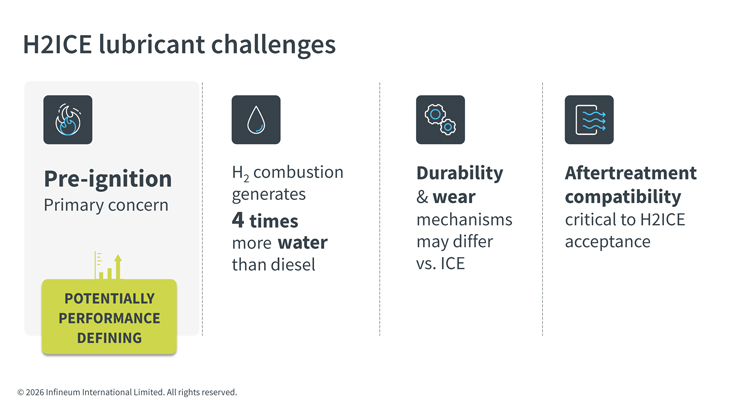
Water accumulation, durability, wear and aftertreatment compatibility are all important factors to consider. However, OEMs are telling us that pre-ignition is the most significant challenge that needs to be overcome to facilitate the successful deployment of H2ICE into the market.
The very low ignition energy of hydrogen means that H2ICE can experience spontaneous ignition of the fuel ahead of a spark event, which also results in high in-cylinder pressures. This phenomenon, known as pre-ignition, is more prevalent under the high speed and high load conditions encountered in commercial vehicle applications.
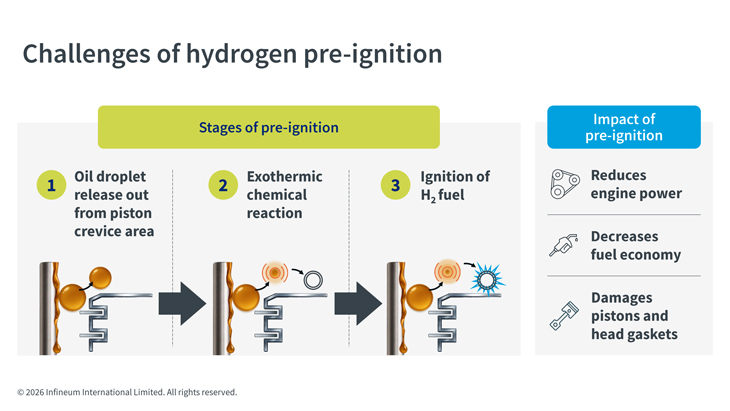
The challenges associated with pre-ignition include:
Reduced engine power output
Reduced fuel economy
Poor engine performance
Inferior vehicle operator experience.
However, by far the most important issue is that severe pre-ignition events can damage engine components and potentially lead to engine failure.
Pre-ignition can result from multiple hardware and operational sources, such as hot spots within the combustion zone, residual hot gases and sub-optimal mixing of hydrogen and air. In addition, the lubricant can play a notable role, with lubricant-derived deposits having the potential to insulate metal surfaces and create hot spots. However, the main source of lubricant-derived pre-ignition is thought to arise from lubricant droplets that are ejected from the piston rings into the combustion chamber. These droplets can act as an ignition source via exothermic chemical reactions, such as chemical degradation of additive compounds. The released energy is sufficient to ignite the hydrogen/air mixture, which means combustion occurs ahead of the spark event.
Direct combustion of the lubricant itself is not thought to be a leading cause of pre-ignition. In research, neither the autoignition temperature nor the flashpoint of the oil have shown a correlation with the rate of pre-ignition. The chart below shows that despite the limited variation in both flashpoint and autoignition temperature of five test oils, a large variation in pre-ignition rate between them was observed. This testing suggests that the chemical composition of the lubricant has a more significant impact on pre-ignition than its physical properties.
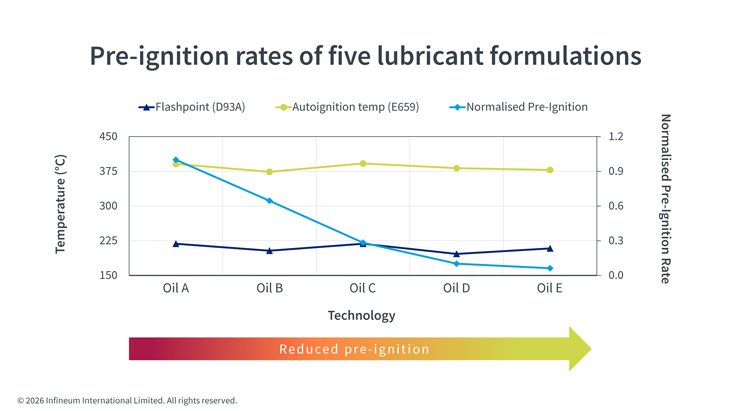
Pre-ignition shows little correlation to the physical properties of the oils tested
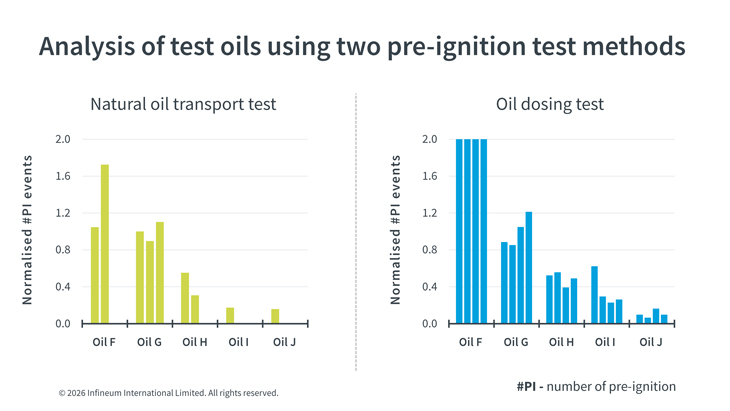
Test selection is a key element of gaining a clear understanding of the impact of lubricants on pre-ignition. It is important, for example, to ensure that tests can minimise hardware-derived pre-ignition since lubricant optimisation is unlikely to overcome, or substantially mitigate, deficiencies in hardware or engine operation. Infineum has used two pre-ignition test methods to investigate the impact of lubricant composition on pre-ignition. The tests differ in a number of ways including engine size and type, operating conditions and most notably the candidate oil delivery method.
In one test method, lubricant-derived pre-ignition occurs as a result of the ejection of oil into the combustion zone from the ring pack (‘natural oil transport’). In the other test, known as the oil dosing test method, the candidate oil is artificially introduced into the combustion zone of the engine via the air intake manifold. Both test methods have been shown to be statistically repeatable and capable of clear and comparable differentiation between lubricant formulations.
While they are similar phenomena, pre-ignition in H2ICE is not the same as gasoline low-speed pre-ignition (LSPI), which has been studied extensively. Hydrogen pre-ignition occurs under a wider range of engine conditions and the lubricant formulation responses are not the same as observed for LSPI. This means that a lubricant formulated to minimise gasoline LSPI cannot be expected to offer the same protection in a hydrogen engine, and vice versa. In our view, it is vital that a dedicated hydrogen pre-ignition test is developed to ensure lubricants are optimised to deliver the required protection in H2ICE.
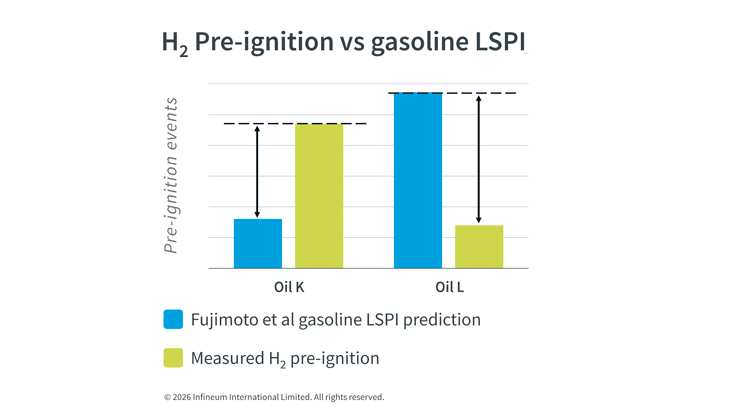
Using existing gasoline LSPI approaches may result in a lubricant with very poor H2 pre-ignition
Infineum has undertaken extensive pre-ignition testing. Through fundamental research our technologists have built up a deep understanding of the different contributions of various additive, base stock and viscometric combinations. This knowledge enables optimised lubricants to be designed across a wide composition map. Benchmarking of existing heavy-duty lubricant technology has shown a broad range of capabilities, with some existing formulations exhibiting strong ability to minimise pre-ignition. However, bespoke development and reformulation can ensure optimal pre-ignition performance.
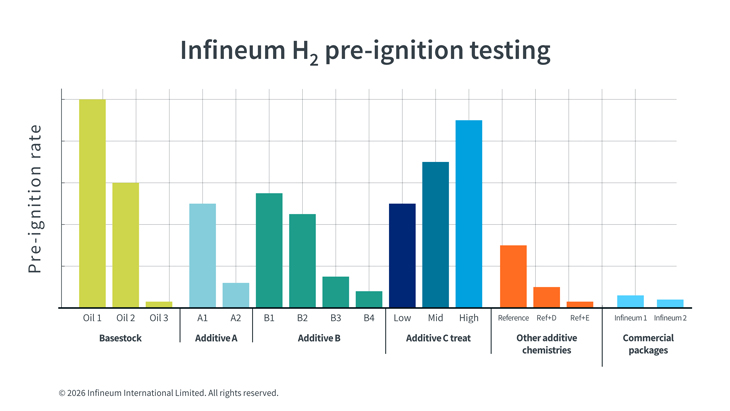
Lubricants with optimised pre-ignition can be formulated across a broad composition map
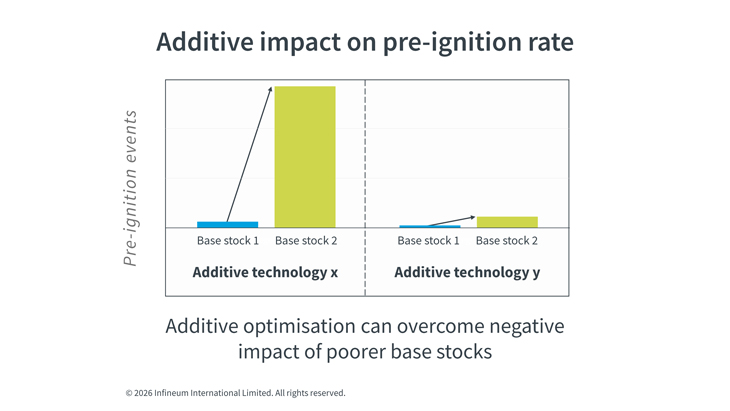
While base stock type can have a significant impact on pre-ignition rate, optimisation of the additive formulation is critical. A strong additive technology can reduce the negative impact of a weaker base stock; thus allowing flexibility in base stock selection, which may be driven by availability, price or other performance criteria.
While the market for H2ICE is still nascent it is difficult to predict what the industry will require and value in lubricants developed specifically for this new application. Infineum has been investigating three key approaches: bespoke, boosted and suitable for use.
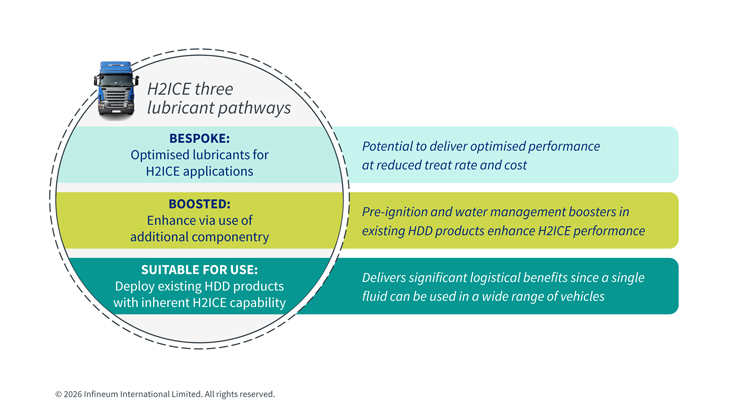
In our view it is essential that lubricants intended for use in H2ICE are assessed for their pre-ignition capability. Existing heavy-duty engine oils, designed for diesel ICEs, may well be able to provide acceptable performance in H2ICE. However, it is likely that, as hydrogen engines become more widely established in the market, there will be a growth in demand for lubricants specifically formulated for this application. Infineum will be ready with the chemistries needed to support the roll out of hydrogen-powered engines.
This however is not the complete story regarding H2ICE lubrication. Infineum is also working to assess other performance benefits that lubricants can deliver in this new environment.
Sign up here to make sure you don’t miss the next Insight article where we will share more findings on H2ICE. Visit our Alternative Fuels knowledge hub for more information and follow Infineum Additives on LinkedIn.
Sign up to receive monthly updates via email