Why hybrids matter
Severe hybrid engine oil testing
20 May 2025
24 March 2026
How a multi-technology approach could help to meet decarbonisation goals faster

With battery electric vehicles dominating media headlines, investment flows, and policy discussions, it can seem that the automotive industry has just a single, fully electric path to net zero. Yet the reality is far more complex. Insight reports on a session delivered by Ingo Scholten, Deputy CTO of Horse Powertrain, at the CTI Symposium. It explored how achieving faster global decarbonisation, while also ensuring a competitive and profitable automotive industry, requires a multi-technology approach that reflects different consumer and regional needs.
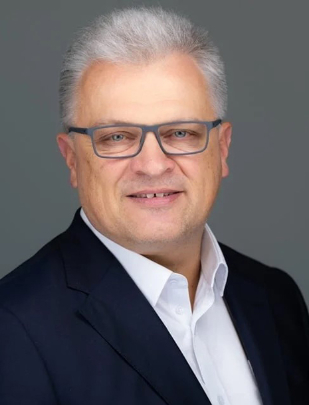 Ingo Scholten, Horse Powertrain
The 20th CTI Symposium held in Berlin, hosted more than 650 delegates and a number of expert speakers from across the automotive industry. The event covered the latest developments in electrified drivetrains, hybrid solutions, energy systems, software integration, and mobility strategies. In his session, Ingo Scholten, from global powertrain specialist Horse Powertrain, showcased how a multi-technology approach, including various hybrid systems, is key to reaching net zero.
Ingo started his presentation with an overview of how the vehicle parc of the future may look. “If you believe the forecasts, around the globe, in 2040 six out of ten vehicles will still contain an internal combustion engine (ICE) in one form or another, that’s one billion vehicles on the road with an ICE. That means every combustion engine we develop now or sell today might still be in use 15 years from now.
So I think we have an obligation to continue to work on optimising those systems.”
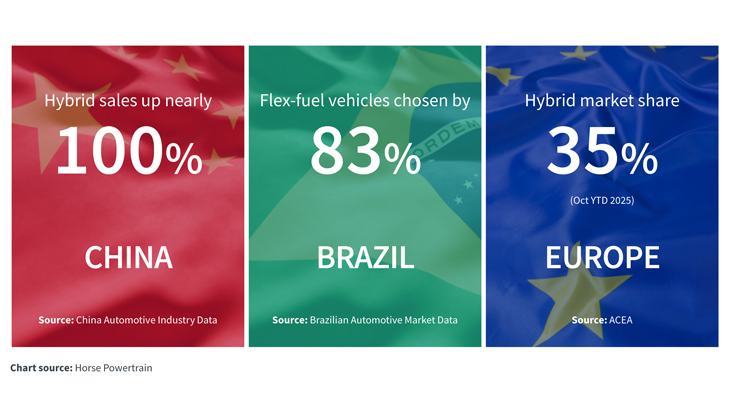
However, as Ingo continues, data shows that vehicle powertrain choice across the globe is far from uniform. “China last year saw 100% growth in hybrid products, which outpaced battery electric vehicles. In Brazil a different picture is emerging, with bioethanol powered vehicles making up more than 80% of sales. While here in Europe, the market share of hybrids has risen to 35% - growth that the region has not seen before.”
Ingo goes on to highlight the significant challenges that may emerge if global decarbonisation efforts follow an electric-only path. “We see that 60% of global energy is still being generated from fossil fuels and 30% of that is coal-based. So in countries that have a coal-based grid, driving a battery electric vehicle (BEV) could result in higher lifecycle emissions versus a hybrid. Plus there is growing competition for the available energy, particularly from artificial intelligence and cryptocurrency. And, of course, there are charging infrastructure availability issues in some areas – making BEVs better suited to urban driving rather than long distance travel or rural use."
"In addition," he continues, "if you consider material use, an 80 kilowatt hour BEV battery will use roughly 20 times more material than a 1.8 kilowatt hour hybrid battery. Moving to full-electric overnight would demand rapid expansion of mining activities for cobalt, lithium and other critical minerals that would not be easy to achieve. All these challenges mean, in my opinion, we need parallel solutions – not just a one solution fits all. For us at Horse Powertrain, that means hybrids, renewable fuels and other solutions.”
“I don’t see a global ‘one technology fits all’ approach, rather it will be shaped by regional energy availability, infrastructure maturity, consumer behaviour, and economics.”Ingo Scholten, Horse Powertrain
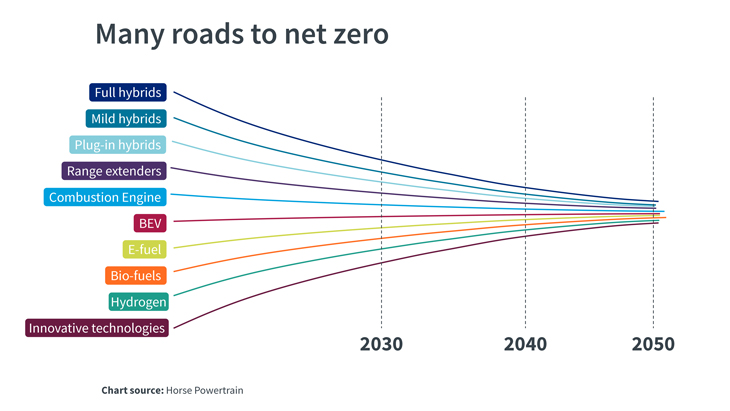
Getting to net zero will need a mix of technologies - not a one solution fits all approach
Reaching net zero emissions is not going to happen overnight and, in Ingo’s view, more than one technical solution is required to facilitate faster global decarbonisation. “That reality doesn't divide technologies it connects them and I think hybrid systems, renewable fuels, and battery electric vehicles will all have roles to play in the future. As a global powertrain specialist that is independent, agile, and built for partnerships, Horse Powertrain is working with OEMs and their partners to better understand the problems that our industries face and to find collective solutions. We are a joint venture, 45% Geely, 45% Renault and 10% Aramco, combining legacy with hunger. But, we don't build cars, we build what moves them - the powertrains - and we need diverse solutions, from manuals and dual clutch systems to dedicated hybrid transmissions and electric drive units, to meet different customer needs.”
As Ingo continues, electrification has undoubtably brought a number of good things to the vehicle design and architecture. Customers now have expectations that vehicles of the future will be as good, if not better, in terms of all the features and benefits they deliver.
“If we take electric drive units (EDU), as an example, these are relatively simple and compact systems that offer a number of benefits. Compared to a traditional hybrid powertrain system, an EDU is roughly 40% narrower, which translates to a smaller engine bay. This allows design improvements to be incorporated such as a more effective deformation zone to improve crash performance, a shorter front end providing more cabin space or more space for the batteries and enhanced front suspension for better drivability. In our view BEV customers have grown accustomed to the nimble and smooth driving experience and advanced connectivity, infotainment and other systems that are all part of the latest architectures.”
“If customers move from BEV to plug-in hybrids they will expect the same performance and driving experience, which creates a clear challenge for hybrid developers.”Ingo Scholten, Horse Powertrain
“To meet these expectations,” he continues, “we must design and package hybrid systems so that they can be seamlessly integrated into next generation vehicle architectures without disturbing the improvements that electrification brings. Our focus has been on systems that are specifically designed to meet different customer needs and specific regional requirements.”
Ingo finishes his presentation with a brief conclusion. “I think systems can be designed to match the needs of both urban and rural drivers while also offering different energy sources based on local availability. Being agile allows technologies and more sustainable mobility to be delivered to end users faster. In my view, it's all about the results that can be achieved, on how much carbon these technologies reduce. At the end of the day, it's one planet with many roads, and one shared goal – net zero emissions. To get there it will be important for industry stakeholders to cooperate to deliver a diverse range of technologies that may help meet decarbonisation goals faster than any single technology could alone.”
Finding the best route to net zero is undoubtably complex. Reaching the goal means the co-optimisation of engines, transmissions, aftertreatment systems and control software will be increasingly important. In turn, designing lubricants that can deliver the optimal performance in these evolving systems will require close cross-industry collaboration. Infineum is ready to take on the latest challenges, with formulations that can meet OEMs’ expectations for durability and efficiency for electrified and conventional vehicle platforms.
Sign up to receive monthly updates via email