Lubricant trends
Advances in automotive lubricant design
04 March 2025
17 February 2026
Infineum discusses innovative ways to meet evolving OEM specifications and performance demands at ICIS London

The ICIS World Base Oils and Lubricants Conference is always packed with new ideas and insights, while also providing a great platform for industry leaders to share their thinking. The 30th year anniversary event, held recently in London, was certainly no exception. Insight reports on the engaging session delivered by Andrea Ghionzoli, Infineum Head of Operational Marketing for EMEA, showcasing how advanced lubricant technology is evolving to meet rapidly changing OEM specifications and increasingly demanding performance expectations.
The recent ICIS World Base Oils and Lubricants Conference played host to more than 600 delegates from across the world. Over the past 30 years, the event has built up a reputation for being the place where the industry’s most influential leaders meet, make decisions and shape the future. The 2026 event was packed with industry insights and market expertise, with more than 32 hours of presentations, more than 60 engaging speakers, panel discussions and training sessions along with countless opportunities to network with familiar and new faces.
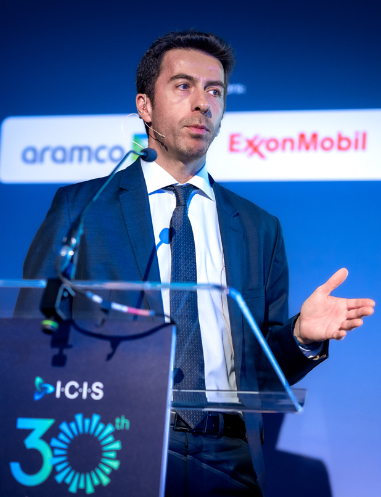 Infineum Head of Operational Marketing, Andrea Ghionzoli
As Digital Sponsors, Infineum played a key role in the event and was invited to contribute a session on the exciting times ahead for future lubricant formulations. Infineum Head of Operational Marketing, Andrea Ghionzoli, started his presentation by highlighting some of the key drivers for change in our industries.
"The combined pressure of tightening regulations, geopolitical tensions, accelerating sustainability goals, shifting powertrain strategies, and heightened cost‑to‑value expectations are impacting all of our industries. At the same time, the global transportation industry continues to be driven by the need to provide valuable and durable solutions. These must not only appeal to buyers and comply with mandated requirements but also contribute to wider sustainability
and decarbonisation aspirations.
In my opinion, that is exactly why formulating for the future matters.”
While sales of battery electric vehicles (BEV) are continuing to grow, recent figures show they are at a slower pace than previously predicted. One trend Andrea sees emerging as a result of these shifting consumer buying patterns is a change to some OEM strategies. “Following this pull from the market, many OEMs are putting the internal combustion engine (ICE) back into their strategic product mix. This means we can expect the ICE to continue to play a key role in future cars, such as hybrids, which means OEMs need to continue to invest to improve its efficiency. Internal combustion engines are evolving quickly, engines are becoming more compact, using advanced materials, and adopting new injection, ignition, and combustion designs, all of which increase thermal and mechanical stresses on the oil.”
“In addition,” Andrea continues, “I am seeing an increase in the use of alternative fuels, including biofuels, the introduction of advanced aftertreatment systems, and the rise of next‑generation hybrids, including the new range‑extender engines. All this activity adds even more complexity, requiring lubricants with stronger protection, stability, and compatibility. The acceleration in engine and aftertreatment innovation combined with increased alternative fuel use means lubricants must evolve quickly and I expect the demand for advanced, novel, engine oils and driveline fluids to increase as a result.”
“In my view, every one of these changes introduces new lubrication challenges.”
Far from being fully battery electric, Andrea expects the future of transportation to be one where traditional and emerging vehicle propulsion technologies coexist. “This means lubricants will become even more critical enablers since they must support efficiency improvements, hardware durability, emissions reduction, and long‑term reliability across diverse applications. In the middle of the requirement to deliver performance, sustainability and value there is a very narrow operating space from which the lubricant must deliver all these attributes through the value chain right to the end consumer.”
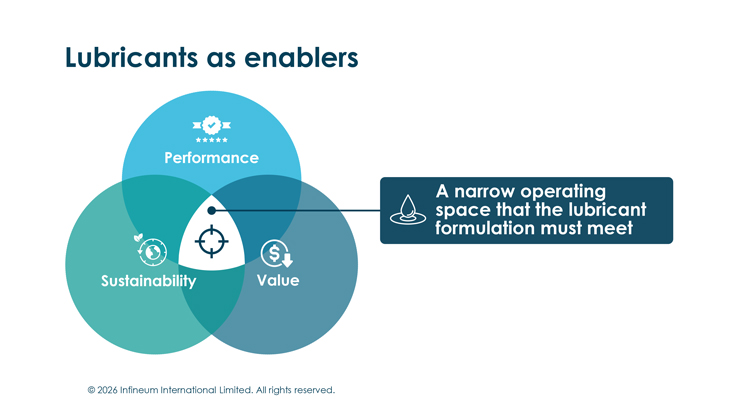
As engines become more efficient and emissions regulations tighten, there is a clear and growing need for high‑performing lubricants. Andrea continues his presentation with a look at how lubricant development will continue to evolve. “We must support new hardware, fuels, and drive cycles, while protecting increasingly sensitive aftertreatment systems through lower sulphated ash, phosphorus and sulphur (SAPS) levels and superior cleanliness, wear protection, and fuel economy. The lubricant is also being asked to embrace and enable more sustainable solutions, whilst lowering the Product Carbon Footprint. Additionally, oils must deliver retained performance, enabling longer engine life and strong value across extended oil drain intervals.”
With ICEs expected to be in vehicles for many years to come, Andrea explains how the ability of high-performance lubricants to improve engine efficiency, while maintaining hardware durability, continues to be a valuable attribute. “Reducing the viscosity grades of passenger car formulations, with SAE 5W-30 and SAE 0W-20 now the main grades for service fill and factory fill oils respectively, has clearly been one successful approach that has been employed. Now, this same approach, although at slower pace, is happening for commercial vehicles. Novel and tailored components and new ways of formulating them enable us to develop lower viscosity grades. But, in addition to the contribution from lowering the lubricant viscosity, the use of thinner additives, novel and tailored components and new ways of formulating can also contribute to fuel economy improvements.”
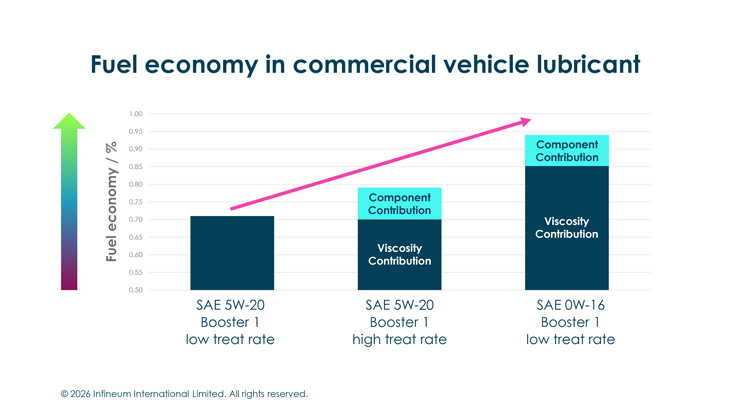 Optimising additive choice and viscosity grade delivers optimal fuel economy performance, while maintaining durability
However, it is not just fresh oil that must deliver these performance attributes as Andrea continues. “It is important for oils to deliver retained performance over longer oil drain intervals, in both passenger cars and commercial vehicle applications for maximum longevity and value. Our carefully designed formulations continue to deliver fuel economy credits even when the lubricant is aged when compared to fresh oil performance.”
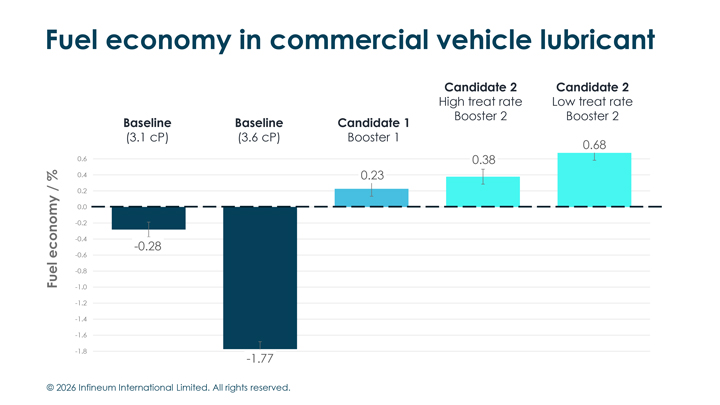 Differentiation in retained fuel economy performance across range of different formulations
“In addition, he continues, “regulators and automakers worldwide are introducing tighter requirements on efficiency and emissions, which increases demand for advanced engine oils that can deliver cleaner operation, fuel savings, and long-term protection. A careful balance of additive chemistries and base oil is needed to meet the most demanding standards of modern engines, with proven performance in the latest OEM tests and supporting the latest generation of vehicles with OEM-approved performance.”
To remain leaders in sustainable transportation additives, it is vital for Infineum to explore and understand the latest developments. Before Andrea closed his presentation he took time to look at some of the challenges presented by the use of alternative fuels.
“The future fuels landscape is evolving and is expected to become even more diverse in the future."
"Availability and uptake of the various fuels, including biofuels, methanol, ammonia and hydrogen, is likely to be substantially different across the regions - based on feedstock and infrastructure availability, government incentives and the speed of commercialisation of alternative fuel capable vehicles and vessels. The use of alternative fuels, with a lower (or zero) carbon footprint, is especially important to the decarbonisation of commercial engines, where powertrain electrification is more difficult. However, these fuels are not all equal in terms of their contribution to sustainability goals, fitness for use in fleet operations or refuelling infrastructure and powertrain availability.”
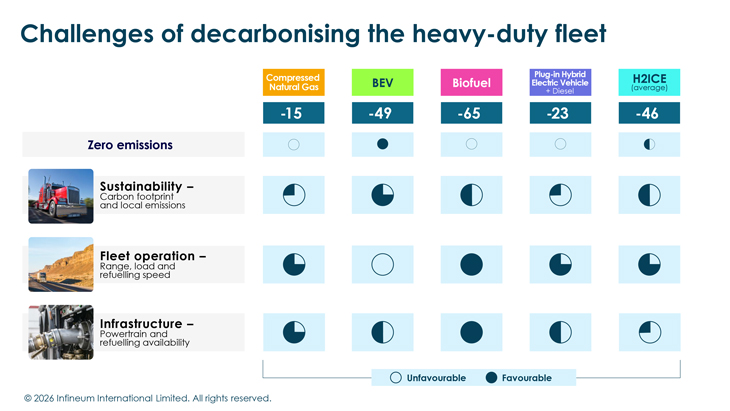
“With so much choice, I expect to see a multi-fuel and multi-technology future as we transition to net zero.”
One of the future options for transportation is using hydrogen in an internal combustion engine, known as H2ICE, which Andrea sees as a good fit for many applications, including heavy-duty vehicles. “Moving to hydrogen from the fuels we know and use to today is not straightforward. It raises a number of different challenges for the lubricant and, as we gain more experience, these challenges are likely to continue to evolve. Today, the key issues we must help to overcome are water accumulation, novel durability and wear challenges, aftertreatment compatibility and pre-ignition.”
Since pre-ignition is a primary concern for many OEMs, and is formulation defining for the lubricant, Andrea highlights the challenges it poses. “The key issue is that the existing tests for gasoline low-speed pre-ignition (LSPI) cannot predict pre-ignition in H2ICE applications. H2ICE pre-ignition does not respond to the same additive chemistry as gasoline LSPI, which means that to ensure an optimum formulation is delivered, dedicated H2ICE pre-ignition testing is essential.”
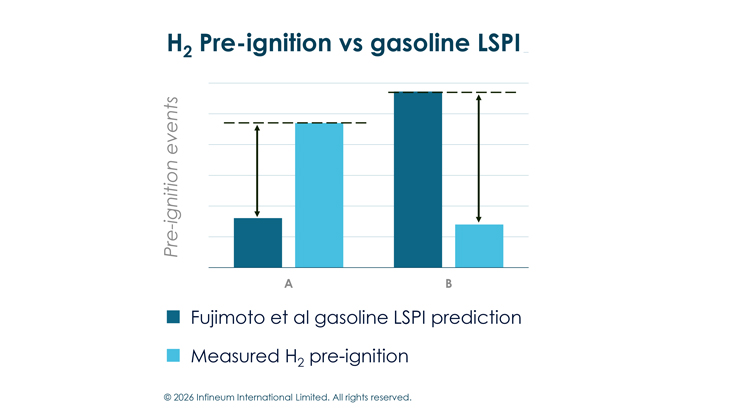 Using existing gasoline LSPI approaches may result in a lubricant with very poor H2 pre-ignition
“Our technical teams at Infineum have measured and quantified the issues, developed a statistically robust and repeatable pre-ignition test and used it to assess a broad range of lubricant formulations. In our research we have found the pre-ignition rate changes depending on the additive and lubricant composition: different base stocks, different additive components and treat rates, chemistry that can act as pre-ignition suppressors.”
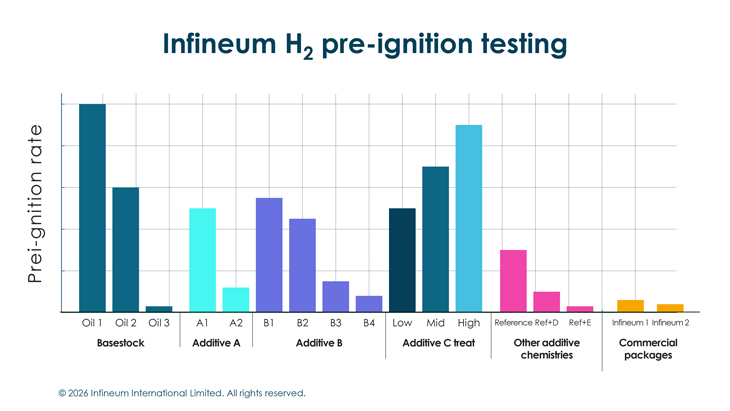 Lubricants with optimised pre-ignition can be formulated across a broad composition map
This extensive testing has generated a large performance database and, as Andrea explains the learnings from it are being incorporated into additive packages, leading to lubricants with optimised pre-ignition capability formulated across a broad composition map. “We are continuing to collaborate with OEM and partners as they evolve their H2ICE engines. Since the energy transition will take time in this sector, it is inevitable that legacy and emerging technologies will coexist, which creates challenges regarding lubricant compatibility. As fleet operators look to simplify logistics, they may favour universal lubricants that can work across many powertrains and fuel types – but achieving this performance in a single formulation is an increasingly complex challenge. While existing heavy-duty engine oils, designed for diesel ICEs, may be able to provide acceptable performance in H2ICE, I think this market will demand oils that have been specifically formulated for this application."
"Advanced H2ICE formulations will deliver superior performance in the most severe conditions against all drive cycle challenges."
Andrea concludes: "It’s an exciting time and Infineum is investing to stay at the front of the developments needed to respond to the growing hydrogen market.”
Sign up to receive monthly updates via email